


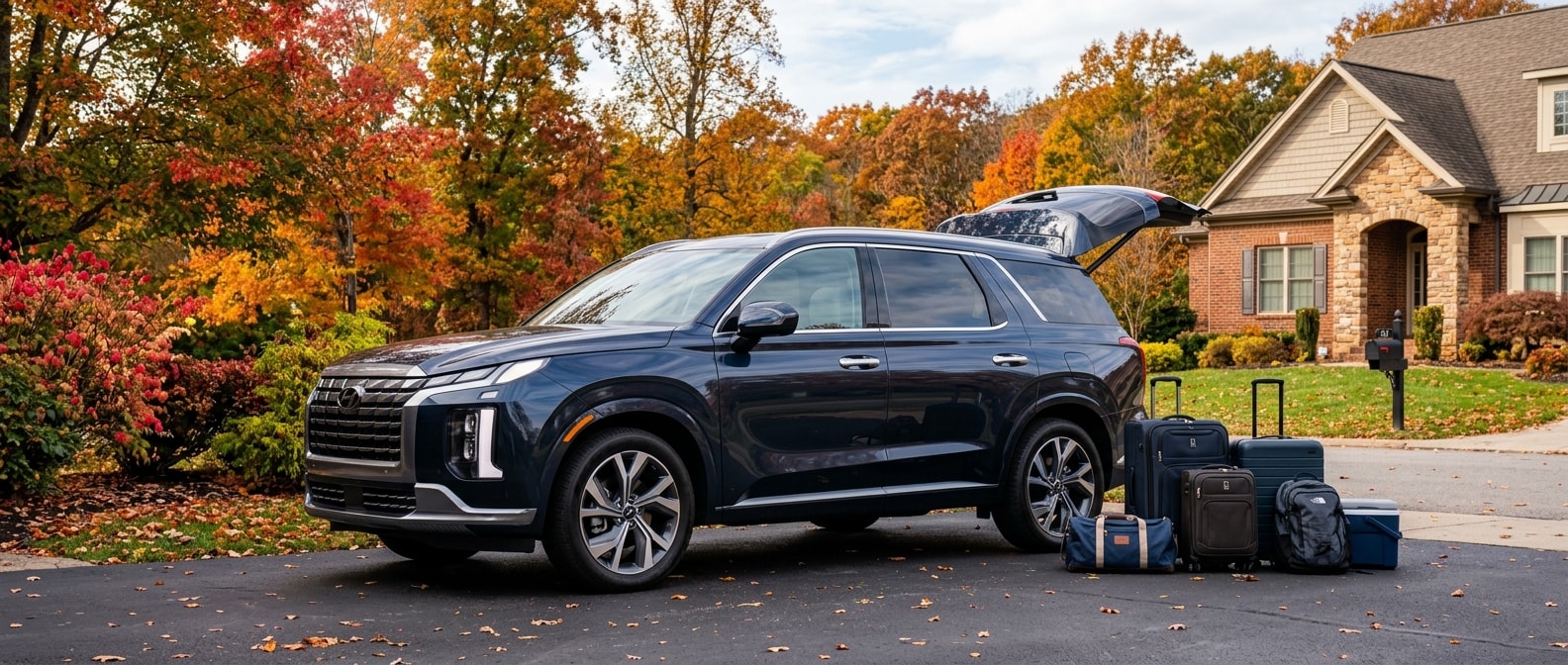
Hyundai offers the 2027 Hyundai Palisade in eleven trims across two powertrains, with two seating layouts and an optional off-road package that isn't just a cosmetic badge. You're looking at a lot of configuration surface, and we've watched buyers get turned around by starting with cabin finishes instead of the decisions that actually constrain everything else.
Our short answer is simple. Pick powertrain first, seating layout second, capability third. Do it in that order and every trim decision downstream gets simple.
The Palisade Hybrid makes 329 hp combined and earns an EPA-estimated 34 mpg combined (FWD), 13 mpg more than the gas V6 and more power too. The tradeoff worth watching is tow capacity. The hybrid is rated at 4,000 lbs, and the gas V6 reaches 5,000 lbs when properly equipped. Know your tow number before you pick the engine.
What Do You Need Before You Start?
You really only need three numbers before you open a trim sheet, and pinning them down up front keeps you from backtracking through eleven trims later. Know your weekly commute distance, your maximum regular passenger count, and your tow number if you have one. Get those clear first. Below is the spec grid you'll be making decisions against.
| Decision Point | Gas V6 (3.5L, 287 hp) | Palisade Hybrid (2.5T + 2 motors, 329 hp) |
|---|---|---|
| EPA combined mpg (FWD) | 21 mpg | 34 mpg |
| EPA combined mpg (AWD) | 20 mpg | 29-31 mpg (varies by trim/wheel size) |
| Max tow capacity | 5,000 lbs | 4,000 lbs |
| Transmission | 8-speed automatic | 6-speed automatic |
| XRT Pro available | Yes | No |
| Seating (standard) | 8 (bench) or 7 (captain's chairs) | 8 (bench) or 7 (captain's chairs) |
| Third-row legroom | 32.1 inches | 32.1 inches |
| Cargo behind third row | 19.1 cu ft | 19.1 cu ft |
| Cargo, all rows flat | 86.7 cu ft | 86.7 cu ft |
One thing the table above can't capture is low-end feel. The hybrid's dual electric motors create noticeably more low-end response than the naturally aspirated V6. The efficiency story shows up in the EPA's numbers, and the torque character tells the driving story. They point in the same direction.
The Five Configuration Decisions, in Order
Step 1: Pick Your Powertrain
Powertrain is the one decision you can't reverse without changing the vehicle. Everything else is trim and options.
Gas V6 makes the most sense if: you tow consistently near the upper end of that capacity range (a 20-foot pontoon, a loaded camper), or you specifically want the XRT Pro trim and its off-road hardware. The 3.5-liter V6 produces 287 hp and 260 lb-ft of torque. The EPA rates the FWD gas Palisade at 19 city and 25 highway, or 21 mpg combined. For a 199-inch, three-row SUV, that's a reasonable number.
Hybrid makes the most sense if: you commute day in and day out through the Nashville corridor or do a lot of suburban stop-and-go. Hyundai pairs a turbocharged 2.5-liter four-cylinder with two electric motors for a combined 329 hp and 339 lb-ft of torque. The EPA-estimated 34 mpg combined (FWD, Blue and SEL Premium trims) holds up in everyday driving, a genuine 13-mpg jump over the V6. And the hybrid doesn't plug in. It manages itself through the drive cycle and regenerative braking. You charge it by driving.
We'll name one tradeoff plainly. If you're pulling a loaded boat or a travel trailer week after week, the hybrid's 4,000-lb ceiling leaves less margin. The gas model's 5,000-lb rating is the right tool for heavier towing. Pick the engine for the thing you'll do every week, not for the trip you take twice a year.
Step 2: Choose FWD or AWD
Both powertrains come standard with front-wheel drive and offer HTRAC AWD as an option. The XRT Pro is AWD-only (gas) and is the one exception to that pattern.
AWD trims a few mpg in every setup. FWD keeps the better efficiency number.
On the gas V6, FWD gets 21 combined and AWD gets 20. On the hybrid, the FWD SEL and SEL Premium reach 34 combined, while the AWD versions of the same trims come in around 29 to 31 (larger wheels on Limited and Calligraphy trim the number further). The Palisade Hybrid offers HTRAC AWD on every trim level, so you're not locked out of efficiency if you want the all-weather traction.
Middle Tennessee gets genuine ice events in winter. If this is your household's primary vehicle through December, January, and February, AWD earns its keep, not just a checkbox. If your daily route is mostly interstate miles in mild conditions, FWD on the hybrid is a cleaner efficiency equation.
Step 3: Choose Your Seating Layout
Seating is the second irreversible call, and you're deciding between seven seats and eight. Both layouts carry across the lineup.
Seven-passenger configuration means second-row captain's chairs with a fixed aisle between them. Walk-through access to the third row is genuinely easy. The chairs are more comfortable on longer drives. Captain's chairs are standard on the SEL trim and above on both the gas and hybrid Palisade.
Eight-passenger means a second-row bench for full-width seating across the middle. Bench availability now extends to the Limited trim in the 2027 update (new for this model year), which matters if you need all eight seats on any kind of regular basis.
For daily reality, our read is simple. If kids are climbing into that third row more than twice a week, the captain's chair aisle makes life noticeably easier. A bench earns its place when you actually need eight seats. The better question is which aisle you'll stand next to in a parking lot at school pickup.
Third-row legroom lands at 32.1 inches. Hyundai grew the wheelbase by 2.7 inches in this redesign specifically to address what was always the Palisade's softest spot. Teenagers fit. Adults manage it for shorter hauls. It's a real improvement worth the redesign.
Step 4: Decide Whether the XRT Pro Is for You
The XRT Pro is gas-only, AWD-only, and the only trim that brings genuine off-road hardware rather than an appearance package. The package includes 8.4 inches of ground clearance (every other Palisade trim sits at 7.4), 255/60R18 all-terrain tires, an electronic limited-slip rear differential exclusive to this trim, terrain-specific drive modes (Mud, Sand, and Snow), front and rear recovery hooks, a factory-standard tow hitch, and a real-time pitch and roll display. That's a capable setup.
The tradeoff is efficiency. The XRT Pro's EPA rating is 16 city, 22 highway, and 19 combined. If you're using that capability on recreational trails, park roads, or the kind of terrain east of Nashville where paved roads end, the XRT Pro earns that fuel trade. If you're doing five days a week of highway commuting and you like the styling, one of the other trims delivers the same cabin with a better mpg story.
Worth saying clearly, the XRT Pro's electronic limited-slip rear differential is trim-exclusive. You can't add that hardware to an SEL Premium or a Limited. If you want it, the XRT Pro is the only way to get it.
Step 5: Pick Your Trim
Once you've locked in the four decisions above, trim is mostly about the interior features you want and the seat material you prefer. A handful of signposts can guide the trim call.
Gas lineup (SE through Calligraphy): The SEL Premium is the value standout. It adds ventilated front and rear seats, a surround-view camera, heated steering wheel, panoramic moonroof, and driver memory without reaching the Limited's tariff. The Calligraphy tops the gas range with Nappa leather seating, available relaxation modes that adjust front and rear seats toward a zero-gravity position, and 21-inch wheels.
Hybrid lineup (SEL through Calligraphy Black Ink): The SEL Premium is again the value anchor. The new-for-2027 Calligraphy Black Ink trim caps the hybrid lineup with black exterior accents, black alloy wheels, and coordinated black interior trim. It's hybrid-exclusive, and it's visually distinctive in a way the rest of the Palisade range isn't.
The step that's easy to get backward: shopping for a trim level before committing to the powertrain. The cabin content of the gas Calligraphy and the hybrid Calligraphy is nearly identical (same Nappa leather, same seats, same dual 12.3-inch displays). Choosing between them comes down to the engine, not the cabin. Lock in the powertrain, then the interior.
Frequently Asked Questions
Does the 2027 Hyundai Palisade Hybrid need to be plugged in?
No. The Palisade Hybrid is a conventional hybrid rather than a plug-in hybrid. The system manages its own charge through regenerative braking and the engine during normal driving.
What is the tow capacity difference between the gas and hybrid Palisade?
The gas V6 Palisade is rated to tow up to 5,000 pounds when properly equipped. The Palisade Hybrid is rated at up to 4,000 pounds. If you're regularly hauling a boat, camper, or heavy trailer, check your rig's loaded weight against those numbers before committing to a powertrain.
Your Quick-Reference Recap
Run through this list before you visit us, since these few decisions constrain everything else about the build.
- [ ] I know my daily commute distance and how much the hybrid's mpg advantage translates to my driving pattern
- [ ] I've confirmed my tow number (gas = up to 5,000 lbs; hybrid = up to 4,000 lbs)
- [ ] I've chosen my powertrain: gas V6 or hybrid
- [ ] I've chosen my drivetrain: FWD or AWD (remembering AWD is standard on XRT Pro only)
- [ ] I've decided on seating: 7-passenger captain's chairs (easier third-row access) or 8-passenger bench
- [ ] I know whether the XRT Pro's hardware (8.4 in ground clearance, eLSD, all-terrain tires) fits my real use case
- [ ] I'm aware of the 2027 changes: SEL Convenience trim is gone, bench now available on Limited, Calligraphy Black Ink is new (hybrid-only)
- [ ] I want to see at least one gas and one hybrid trim back-to-back before I decide
Have a look at our current 2027 Palisade inventory to see which trims and configurations are available right now.
By the Hallmark Hyundai Hendersonville Team | September 2026
Categories:
Social


