

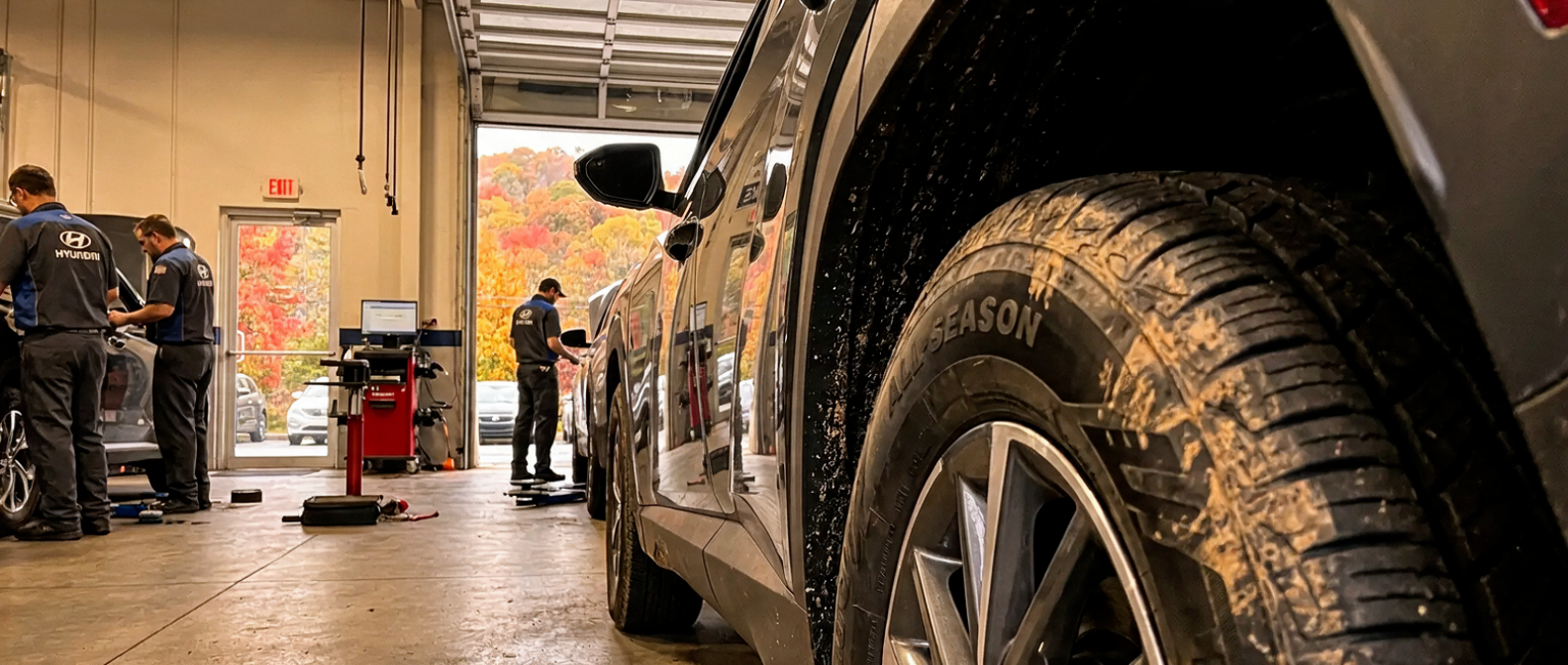
We'll give you the quick answer up front. If you inflated your tires correctly in August and haven't touched them since, they're probably 2 to 3 PSI low right now, and your TPMS light hasn't come on yet. That gap is what matters before Hendersonville's fall rain season starts.
October in Hendersonville is genuinely pleasant to drive through. Highs land in the mid-70s, lows slide toward 40 overnight, and about 3 inches of rainfall spread across the month. The tradeoff is a 30-plus degree temperature swing between your morning commute and the warmest part of the afternoon. That swing is physics. Tire pressure drops roughly 1 PSI for every 10-degree Fahrenheit decrease in ambient temperature. A tire that read 35 PSI on a 75-degree August afternoon can measure 32 PSI on a 45-degree morning without a single puncture, a single leak, or a TPMS warning to tip you off.
Why doesn't the dashboard warn you? Because the TPMS light only activates when pressure falls about 25 percent below the placard spec, per NHTSA's tire pressure monitoring rulemaking. You can be 3 PSI low and driving on a wet road with no warning at all.
So that leaves one problem to solve before the rain finds you on the commute up US-31 toward Nashville, and here's how we play it.
Where Do You Start and When Should You Come In?
Book the inspection for this week, ahead of the first serious rain, since a quick pressure set and tread check tells you whether you're facing a five-minute adjustment or a replace-now tire before wet roads arrive. The logistics table below lays out the five inspection points our service team works through, what each one tells you, and what the finding means for a wet-road Tennessee commute.
| Inspection Point | What We Check | Why It Matters for Fall Rain | Quick Take |
|---|---|---|---|
| Tread depth (all four tires) | Measure in 32nds of an inch with a calibrated gauge | At 4/32" or less, wet stopping distance increases sharply. AAA testing at 60 mph found 87 additional feet vs. new tires | Below 4/32" before rain season = replace, not rotate |
| Cold tire pressure | Compare to door-placard PSI before the vehicle has moved | 30-degree day-night swings drop pressure 3 PSI silently; TPMS only catches a 25%-below threshold | Set pressure in the morning, not after driving |
| Sidewall and bead condition | Inspect for cracking, bulging, or embedded objects | Rubber oxidizes over Tennessee summers; cracks widen in cool, damp fall air | A sidewall bulge is a replace-now item regardless of tread |
| Wear pattern (not just depth) | Look across the width of each tire, not just the center groove | One-sided or cupped wear signals alignment or suspension issues that worsen in rain | Uneven wear can mean tread reads fine in the center while edges are already at 2/32" |
| Spare tire condition | Pressure check and visual inspection | A compact spare typically runs at 60 PSI; cold weather drops that too | Spares lose pressure sitting. Check it now, not roadside |
The legal minimum tread in Tennessee is 2/32 of an inch. Our team flags tires at the industry standard of 4/32 inches for wet-road use, because the legal line and the safe-for-rain line aren't the same thing.
The Fit and Maneuver Play for Your Hyundai
Your correct tire size and PSI target both live on the driver-side door jamb sticker, and reading that placard number is what keeps steering predictable on wet fall pavement, even though the sidewall shows a larger figure. If you've been checking the number embossed on the tire sidewall, that figure is the maximum cold inflation for the tire, which sits above the Hyundai-specified operating pressure. They're different numbers on most models, and running at the sidewall maximum on a cool morning can make steering response feel abrupt on wet pavement.
Tucson Hybrid and Santa Fe owners, both models carry TPMS sensors mounted inside each wheel at the valve stem. When you rotate tires (Hyundai's schedule calls for every 7,500 miles, aligned with the oil change interval), the TPMS system needs a few miles of driving to relearn wheel positions. That reset is normal. If the light stays on steady after 10 minutes of driving following a rotation and pressure correction, bring it back in. A blinking TPMS light signals a sensor fault, something separate from a pressure issue, and that does need service attention.
One thing our team catches on inspection that a self-check often misses is wear on the inside shoulder of a tire. On front-wheel-drive Hyundai models pulling double duty as daily commuters, inside-edge wear develops from alignment drift without announcing itself at the center of the tread. You can run the quarter test on the center groove, get a passing result, and still have 2/32 of an inch on the inside edge. A gauge reading across three points per tire catches that. We do it as standard.
Schedule a Fall Tire Inspection
Your Pre-Rain Go-Do-It Checklist
Walk through this five-minute self-check before you book or bring the car in, because it tells you whether you're looking at a quick pressure adjustment or something that really needs a technician.
Schedule a service appointment
Five-minute driveway self-check:
- Quarter test over the penny test. Press a quarter into the tread groove with Washington's head pointing down. If you can see the top of his head, you're at or below 4/32 of an inch, the wet-road threshold rather than just the legal limit.
- Check pressure before you move the car. Use a quality gauge against the door-placard PSI. Mornings are ideal. Don't trust the gas-station readout after driving 10 minutes.
- Inspect each sidewall. Crouch down and look at the full sidewall surface on both sides. Cracks, bubbles, or any raised area means bring it in before driving on the interstate.
- Look at the wear pattern across the full width. Run your palm flat across the tread from inside shoulder to outside shoulder. If one side feels smoother, you've got uneven wear.
- Check the spare. Open the trunk or the undercarriage access. Compact spares typically call for 60 PSI. Fall temperature drops hit them just like the road tires.
- Watch the TPMS behavior. A steady light after pressure correction and 10 minutes of driving means check again or come in. A blinking light means bring it in for sensor service.
- Note the DOT date code. You'll find it on the sidewall, four digits, week then year. Tires from 2020 or earlier are worth discussing with a technician regardless of remaining tread depth.
Once you've run through that list and you want a technician to measure tread depth across all four corners, check alignment-related wear, and set pressure to the door-placard spec, bring your vehicle in for service.
Fall in Hendersonville is a genuinely good time to be on the road. The commute corridor opens up, temperatures stay comfortable, and the scenery along the Nashville suburban belt is at its best in October. Get the tires right first, and you can actually enjoy it.


