

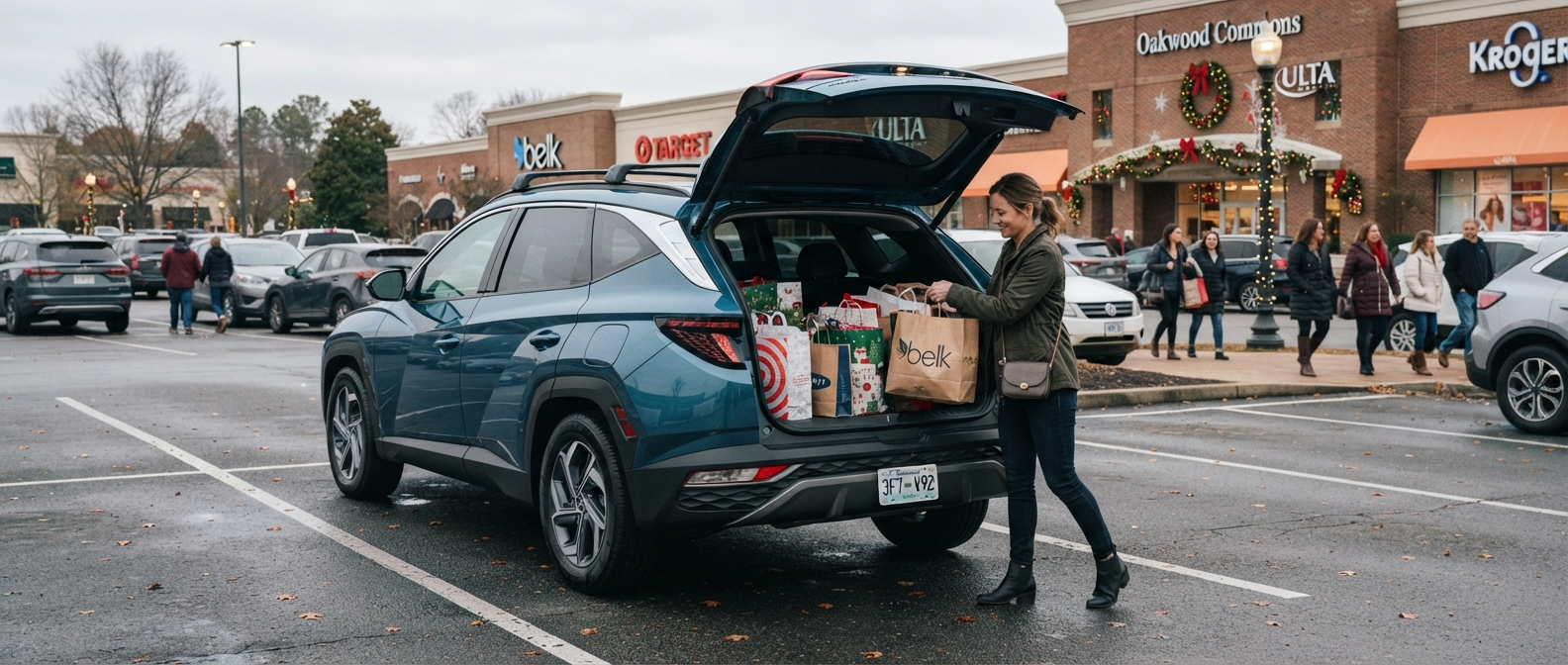
November around Hendersonville doesn't go easy on you. Highs slide from the mid-60s toward 55 degrees as the month wears on, overcast skies turn up on close to half the days, and rain falls on roughly ten days out of thirty (per Weather Spark historical averages). Now stack the holiday errand calendar on top of that. Multiple runs to the Streets of Indian Lake, a Costco haul, school pickups tangled into all of it, and Vietnam Veterans Parkway backed up at 5:15 on a Tuesday. The question isn't really whether the Tucson is good for errands. It's which Tucson, configured which way, fits what your errand day looks like.
This guide settles that. The 2026 Hyundai Tucson comes in gas, Hybrid, and Plug-In Hybrid powertrains across several trim levels, and the right pick changes depending on how far you drive, how many stops you make, and how much cargo you're moving. We work with these trims on our lot, and the tradeoffs here are real and specific.
See the 2026 Tucson lineup at Hallmark Hyundai Hendersonville
- Short, stop-start errand days (under 30 miles): Tucson Hybrid SEL. The 1.6-liter hybrid system shines in exactly this kind of low-speed, repeated-stop driving, and the EPA-estimated 36 combined mpg holds up better in town than the gas model's 28 combined.
- Big single-haul runs (Costco, furniture, bulk): Gas SE or SEL with the 60/40 split-folding rear seats dropped. Hyundai lists 38.7 cubic feet behind the rear seat and up to 74.8 cubic feet seats-down on both gas and hybrid models.
- Mixed day with wet weather and lots of parking-lot maneuvering: SEL or above, any powertrain. That's where you get the hands-free smart liftgate and Rear Cross-Traffic Collision-Avoidance Assist, both matter when your arms are full and the lot at Indian Lake is packed.
- Commute-plus-errands on a longer loop: Tucson PHEV. The EPA-estimated 32 miles of electric range covers a full Hendersonville errand run on electrons before the 1.6-liter gas engine takes over for any Nashville leg.
- Budget-conscious with no compromise on safety: Base SE, full stop. Every 2026 Tucson trim includes the complete Hyundai SmartSense suite, a 12.3-inch touchscreen, and wireless Apple CarPlay as standard equipment.
What actually matters when you're picking a Tucson for holiday errand duty?
Five variables drive the right choice here, and each is worth naming up front, because the best Tucson for you depends on how far you drive, how often you stop, how much you haul, the November weather, and which features you'll pay up for versus actually use. The table below maps them against each Tucson option.
| Tucson Option | Best For | Key Spec (EPA or Hyundai-listed) | Real Tradeoff |
|---|---|---|---|
| Gas SE (FWD) | Minimal errand miles, tight budget | 25 city / 33 hwy / 28 combined mpg | No heated seats, no liftgate. Fine for solo runs, less convenient with cargo or passengers |
| Gas SEL (FWD or AWD) | Everyday family errands, mixed distances | 25 city / 33 hwy / 28 combined mpg (FWD) | Adds heated front seats, hands-free liftgate, 8-way power seat, the sweet spot for most families |
| Gas XRT (AWD) | Occasional off-pavement, terrain-mode appeal | 24 city / 30 hwy / 26 combined mpg | All-terrain tires trade some mpg for mud/snow/sand terrain modes; Indian Lake Boulevard does not require them |
| Hybrid SEL (AWD) | Frequent short errands, stop-start traffic | 36 combined mpg (EPA-estimated, AWD) | Small up-front cost difference vs gas SEL; hybrid battery packaged under rear seats so cargo space is identical to the gas model |
| Hybrid Limited (AWD) | Full-feature errand vehicle, comfort priority | 36 combined mpg (EPA-estimated); Bose audio, ventilated seats, leather | Highest trim cost; justified if you're doing this every day and want the complete package |
| PHEV (AWD) | Commute-plus-errands, home charging available | 32 miles EPA electric range; 77 MPGe combined; 420 miles total | Needs home charging to maximize the EV portion; less compelling without it |
The cargo question is simpler than you think
The cargo answer is simpler and friendlier than the spec sheets suggest, because the hybrid battery doesn't cost you a single cubic foot of storage, and that one fact settles most of the gas-versus-hybrid debate for anyone shopping the Tucson mainly to haul holiday boxes around town. Hyundai packages the battery under the rear seats, which means the Hybrid and the gas model share the same cargo numbers. Hyundai lists 38.7 cubic feet with the rear seats up and 74.8 cubic feet with them folded flat. For context, 38.7 cubic feet handles a full grocery run with room left over. The 74.8 figure is what you're working with when you fold the 60/40 split rear seat and load the flat-pack furniture or the oversized holiday box that doesn't fit in a sedan.
The hands-free smart liftgate (standard on SEL and above) is the feature that changes the experience in a packed parking lot. You kick a foot under the rear bumper and it opens. No gimmick there, not when you're carrying four bags and trying not to set them on wet pavement.
Browse the Tucson Hybrid at Hallmark Hyundai Hendersonville
| Pros | Cons |
|---|---|
| Identical cargo volume across gas and hybrid trims | PHEV has slightly reduced max cargo (battery packaging difference) |
| 60/40 split-folding rear seats on every trim | Hands-free liftgate requires SEL or above |
| Under-floor storage standard on all trims | Roof rails (useful for cargo carriers) start at SEL |
| 74.8 cu ft maximum (gas and hybrid) for big hauls | Folding rear seats removes seating for all five passengers |
See current 2026 Tucson inventory
The powertrain that fits Hendersonville's stop-start errand rhythm
The 2026 Tucson Hybrid earns its case in the stop-start driving a Hendersonville holiday week throws at you, where its 1.6-liter turbocharged engine pairs with an electric motor for a combined 231 horsepower and an EPA-estimated 36 combined mpg on AWD. The gas model's 2.5-liter four-cylinder delivers 187 horsepower and 28 combined mpg. Those numbers come from EPA testing on standardized cycles, and the gap between them narrows some on pure highway miles. It widens on the kind of driving a Hendersonville holiday errand day produces, meaning short runs, frequent stops, and low speeds through shopping-center lots. Stop, go, repeat.
Both the gas and Hybrid Tucson seat five and fold 60/40 in back. The cargo numbers behind the seats stay the same either way.
The PHEV is a different conversation. With an EPA-estimated 32 miles of EV range, it can cover a full errand loop around Indian Lake Boulevard and back home with the gas engine never waking up, provided you've got a Level 2 charger at home. Without home charging, you're paying for a PHEV that often runs as a heavier gas car, and that's the trade in plain terms.
Need more space? See the Palisade for larger family hauling needs
Safety features that actually matter in a busy holiday parking lot
Safety is the great equalizer across the 2026 Tucson lineup, and every trim gives you the same protection, which earns its keep in November rain, in crowded parking lots, and around the hurried, distracted drivers that the Hyundai SmartSense suite was built to manage. Per NHTSA testing, the 2026 Tucson earned a five-star overall safety rating, and IIHS awarded it the Top Safety Pick+ designation. Every 2026 Tucson trim, including the base SE, comes standard with the full Hyundai SmartSense suite. The package covers Forward Collision-Avoidance Assist with pedestrian and cyclist detection, Lane Keeping Assist, Blind-Spot Collision Warning, and Rear Cross-Traffic Collision-Avoidance Assist.
The last one on that list is built for parking lots. Streets of Indian Lake is a shopping center in Hendersonville. When you're backing out of a space there and a cart pusher walks behind you, Rear Cross-Traffic Collision-Avoidance Assist detects the cross-path and can apply the brakes. It works in the low-speed, low-visibility situations parking lots produce. The fact that Rear Cross-Traffic Collision-Avoidance Assist shows up on the base SE matters here. No higher trim required.
The 12.3-inch touchscreen with wireless Apple CarPlay and Android Auto is also standard on every trim. The screen size doesn't change from the base SE to the top trim.
Match the gear to how you actually drive
If your holiday errand day is mostly short hops on Indian Lake Boulevard and Vietnam Veterans Parkway, with a Costco stop and a school pickup folded in, the Hybrid SEL is the trim we'd steer you toward first. It delivers the efficiency advantage where it shows up most, gives you the hands-free liftgate for loaded arms, and adds AWD traction for wet November pavement. All without giving up a single cubic foot of cargo room to the battery.
If you're doing one big run per week rather than multiple short ones, the gas SEL hits the same feature set for a smaller up-front difference. The cargo volume is identical. The safety suite is identical. You give up efficiency on short-hop trips but pick up simplicity.
The base SE isn't a compromise if you don't need the liftgate and you're the only one who rides in it. You get a well-equipped compact SUV with the full safety suite, a solid screen, and 28 combined mpg. The honest version of "you don't need to pay up" is that the SE exists for a reason.
What we wouldn't do is pick the XRT for Hendersonville errand duty. The all-terrain tires and terrain modes are genuinely useful on dirt or mud. Indian Lake Boulevard and the Costco parking lot are not the terrain they were designed for, and the XRT's 26 combined mpg (AWD) reflects the tradeoff.
Frequently Asked Questions
Which Tucson trim is best for holiday errands in Hendersonville?
For most families doing regular short errand runs around Hendersonville, the Tucson Hybrid SEL is the strongest fit. It delivers an EPA-estimated 36 combined mpg on AWD, includes the hands-free smart liftgate, heated front seats, and Rear Cross-Traffic Collision-Avoidance Assist. All features that make a material difference in stop-start, parking-lot-heavy driving. If home charging is available, the PHEV adds up to 32 miles of EPA-estimated electric range, covering a full errand loop without using the gas engine. The base SE is the right answer if features beyond safety and infotainment are not a priority.
Does the Tucson Hybrid have less cargo space than the gas model?
No. Hyundai packages the Hybrid's battery under the rear seats, so the Hybrid and the standard gas Tucson share the same cargo dimensions: 38.7 cubic feet behind the rear seats and 74.8 cubic feet with the rear seats folded flat. The only powertrain that differs is the Plug-In Hybrid, which uses a larger battery and has slightly reduced maximum cargo capacity. For anyone choosing between the gas SEL and the Hybrid SEL specifically for cargo reasons, the numbers are identical.


