


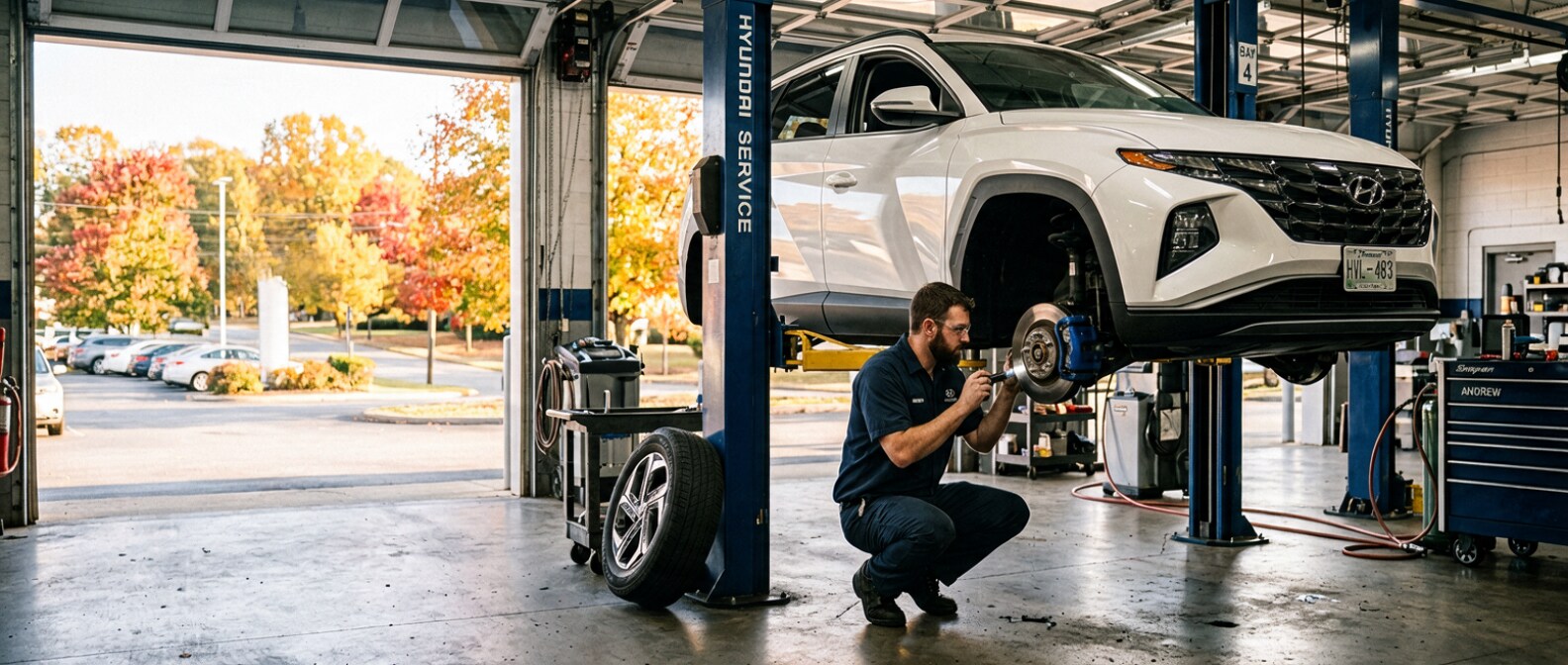
The Wednesday before Thanksgiving is the single busiest travel day on Tennessee roads. If you've driven the I-65 corridor through Rivergate more than twice this fall, your brakes have already soaked up a few hundred extra stop-and-go heat cycles you probably haven't counted.
Generic brake-inspection advice skips that part. It leans on mileage. Our service team watches how you've been driving, because a Hendersonville commute through the SR-386 and I-65 Rivergate bottleneck puts more brake demand on your pads than the same number of miles on open highway. Before you pile holiday traffic on top of that, here's how we think through a brake inspection, and what actually matters for your situation.
The short version
- Pad thickness under 3mm: book it now, before the holiday rush starts.
- Spongy pedal feel or longer stopping distances: fluid or caliper issue, don't wait.
- Morning squeal that clears after a few stops: usually surface rust, not wear, but confirm with a visual check.
- Rotor lip you can feel with a fingernail: rotors are worn past the useful range and pads will follow shortly.
- High-mileage stop-and-go commuter: heat cycles matter more than miles alone.
Schedule your pre-holiday brake inspection
What Actually Matters When You're Choosing a Brake Service?
Not every brake inspection lands on the same answer, and getting that straight before the holidays saves you money and worry. Some situations call for a quick visual and you're done, while others need pad replacement, rotor resurfacing, or a fluid flush. The table below maps the most common conditions to the right action.
| What you're noticing | What it usually means | Action to take | The honest tradeoff |
|---|---|---|---|
| Squeal only on cold starts, clears quickly | Surface rust on rotors after overnight dew or rain | Monitor; likely fine | Annoying, rarely urgent in Middle TN winters |
| Squeal during normal braking that persists | Wear indicator tab contacting rotor (pads near 2-3mm) | Pad replacement soon | Waiting risks rotor scoring, which adds cost |
| Grinding metal-on-metal sound | Pad friction material fully worn, metal-to-metal contact | Same-day service | Rotors likely need replacement too at this point |
| Spongy or soft pedal feel | Moisture in brake fluid or air in lines | Fluid test + bleed | Fluid absorbs moisture over time; this is a real safety concern, not a upsell |
| Pulling left or right when braking | Sticking caliper or uneven pad wear | Caliper inspection | Can cause uneven rotor wear if ignored |
| Pulsating pedal on highway braking | Rotor thickness variation or minor warping | Rotor measurement or replacement | Often shows up after repeated hard stops from speed |
| Dashboard brake warning light | Low fluid (pad wear) or electronic sensor triggered | Inspection immediately | Don't dismiss this one at the holiday deadline |
Brake pads start at roughly 10-12mm of friction material when new. Below 3mm is the replacement threshold most technicians use. By 2mm, the wear indicator is touching the rotor surface.
Pad Thickness and Rotor Condition Are the Core of Every Inspection
Pad thickness and rotor condition are where we spend the most time, because together they tell you most of what you need to know about braking capacity, though neither one alone gives the full picture. Pad thickness is the most direct measure of remaining braking capacity. Brand-new pads carry roughly 10 to 12mm of friction material. The point where our technicians flag replacement is around 3mm. At 2mm, the small metal wear indicator built into the pad is physically contacting the rotor, which is what produces that persistent high-pitched squeal.
Hyundai Tucson owners and Palisade drivers hauling a full family load tend to see front pads wear faster than rear (weight transfer under braking shifts more friction load to the front axle). What matters is knowing where you stand right now, before you add a full holiday load and three hours of I-65 traffic. The wear itself is normal.
Rotors are the second variable. Light scoring on the face of the rotor is expected from normal use. The sign that rotors are due for attention is a noticeable ridge, or lip, at the outer edge where the pad doesn't contact the rotor surface. If you can catch that lip clearly with your fingernail, the rotor has worn significantly and replacing pads alone won't bring braking feel back to where it should be.
A quick tip: when pads are replaced, we always check whether the rotors can be safely reused. Replacing pads on a scored or deeply grooved rotor shortens the life of the new pads quickly and leaves the pedal feel uneven.
Why the Hendersonville Commute Wears Brakes Faster Than the Miles Suggest
Local driving is why your brakes age faster than your odometer suggests, and it's the piece most inspection guides leave out. Hendersonville sits about 18 miles from downtown Nashville via SR-386 to I-65 South. Off-peak, that's a 25-to-30-minute drive. During rush hour, it stretches to 35 to 50 minutes, with the documented bottleneck on the I-65 corridor through the Rivergate area. That stop-and-go section generates repeated brake heat cycles. Each deceleration from 60 mph to a standstill heats the pads, rotor, and caliper, then everything cools before the next stop.
Highway miles, by comparison, involve far fewer heat cycles. A brake system doing two or three Nashville commutes per day is working harder than the odometer reading suggests.
We look at driving patterns alongside mileage when a customer comes in asking whether they're due. Thanksgiving and Christmas add another variable. The I-65/I-24 interchange and the stretch through Rivergate are documented congestion points during holiday travel windows. More stop-and-go piles onto an already brake-intensive routine, on roads that see higher traffic volumes than any other time of year.
Before the holiday push is exactly the right time to check, not after.
Book a brake inspection at Hallmark Hyundai Hendersonville
Schedule Your Pre-Holiday Brake Inspection
Brake Fluid: The Component Most People Don't Think About
Brake fluid is the component that rarely comes to mind, yet it quietly shapes how the pedal feels, because it's hygroscopic and pulls moisture from the surrounding air over time, which slowly lowers its boiling point. When fluid carrying accumulated moisture heats up under repeated hard stops, say three hours in holiday traffic, it can produce a spongy or inconsistent pedal feel that wasn't there on a normal commute.
The color of the fluid in the reservoir is a useful first indicator. Fresh fluid is light amber, almost clear. Dark brown fluid has absorbed significant moisture and it's due for a flush.
Pros and Cons: Professional Inspection vs. Owner Visual Check
| Pros | Cons |
|---|---|
| Professional inspection catches inner pad wear (the side you can't see through the wheel spokes) | Requires a service appointment; minor added time |
| Technician can measure rotor thickness with a micrometer, not just estimate by eye | No specific con for the driver beyond scheduling |
| Fluid boiling-point can be tested with a strip, not just assessed by color | Color check alone won't catch marginal fluid that tests degraded |
| Caliper function checked under load, not just visually | DIY visual check misses a sticking caliper until braking feels off |
| Electronic brake-system codes scanned (ABS, ESC fault codes on modern Hyundais) | Owner can't read ABS/ESC codes without a scan tool |
The inner pad is the one that bites you. An outer pad shows through most wheel spokes, so it's easy to eyeball. Its partner on the inside, sitting between the rotor and the hub, wears at roughly the same rate but needs wheel removal or a flashlight and the right angle to see clearly. Outer pads can look acceptable while the inner pad is at or below the replacement threshold, especially if a caliper pin is dragging slightly.
Match the Service to How You Actually Drive
Matching brake service to your real driving is the honest way to time it, so if you live in Hendersonville and commute toward Nashville four or five days a week, your brakes are doing more work than a driver who covers the same mileage on a rural highway. The stop-and-go pattern on I-65 means more heat cycles per mile. That's worth factoring into inspection timing.
Santa Fe and Palisade Hybrid owners carrying passengers and cargo regularly will see front pad wear accelerate relative to lighter, solo-commuter use. None of that signals a flaw. The cause is plain physics. Heavier vehicle, full load, repeated braking from highway speeds, and the front pads absorb more energy.
The practical takeaway is straightforward. If you're within a year of your last brake service and you drive a loaded family SUV on a stop-and-go commute corridor, a visual check before Thanksgiving is good timing, plain and simple. If you're in a lighter commuter model and your pads were confirmed healthy at your last oil change, a technician's confirmation that you're still in range gives you one less thing to think about over the holidays.
No upsell happens without a clear measurement to show you first. We work that way, every time.
Frequently Asked Questions
How often should I have my brakes inspected?
A visual brake inspection at every tire rotation is a practical baseline. For Hendersonville commuters who regularly navigate stop-and-go traffic toward Nashville, checking pad thickness and fluid condition annually is worth adding to the schedule, especially before the late-fall and winter traffic surge. If you notice squealing, a soft pedal, or the brake warning light, don't wait for a scheduled rotation.
Do I need to replace my rotors when I replace brake pads?
Not always. Rotors can often be reused if they're above the manufacturer's minimum thickness spec and the surface is free of deep grooves or significant heat scoring. If there's a noticeable ridge at the outer rotor edge, or if pad material has worn to the metal and left scoring on the rotor face, replacement is the more cost-effective long-term choice. Pairing new pads with a scored rotor reduces pad life and leaves braking feel uneven. Our technicians measure rotor thickness and assess surface condition before recommending either way.
Categories:
Social


