

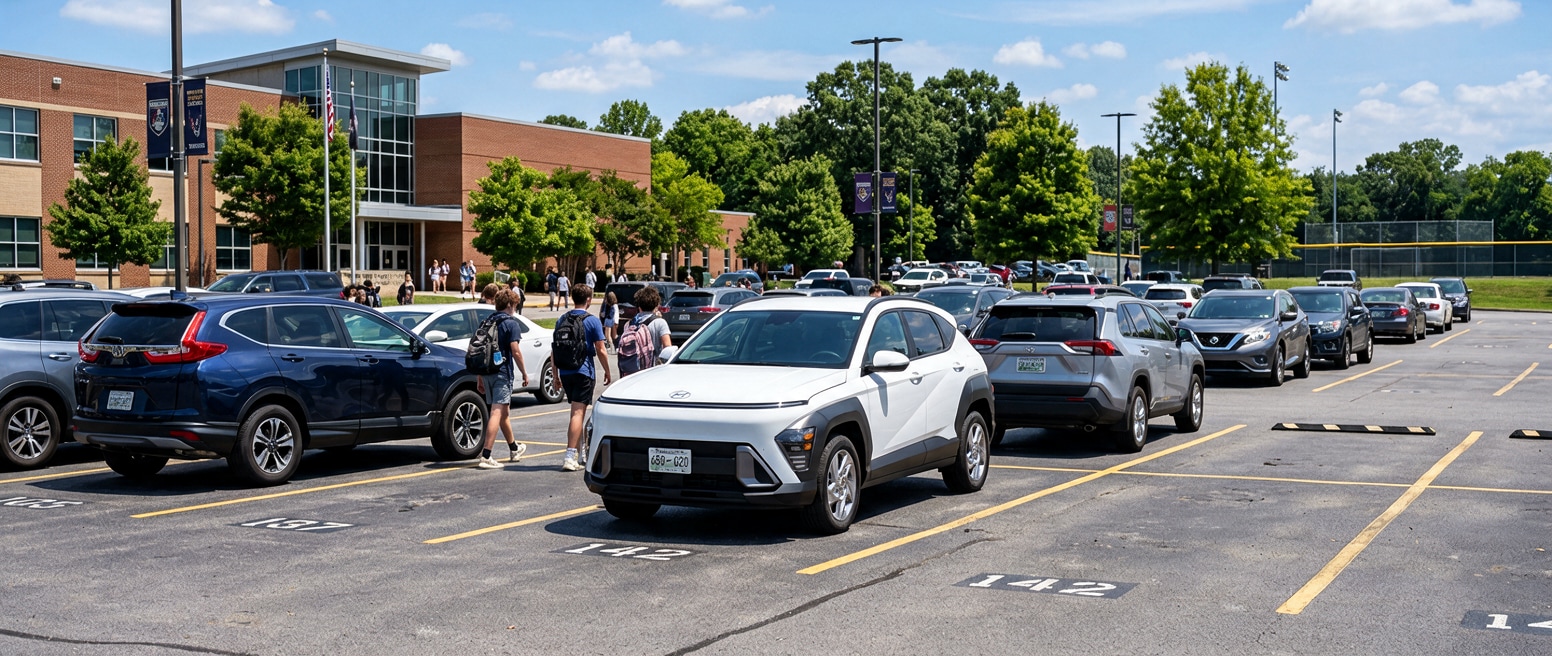
Both SUVs run the same core safety technology, so this decision comes down to your teen's daily reality, not a safety gap that doesn't actually exist.
- Both the 2026 Tucson and 2026 Kona come standard with Hyundai SmartSense (automatic emergency braking, blind-spot monitoring, lane-centering assist, and adaptive cruise) so neither leaves your teen underprotected.
- The Kona earned IIHS Top Safety Pick+ honors. It's also smaller, easier to park, and the EPA-estimated fuel economy reaches 31 MPG combined on the base trim.
- The Tucson carries 41.2 cubic feet of cargo behind the rear seats vs. the Kona's 25.5. If your teen carpools, hauls gear, or drives siblings, that gap is real.
- Solo commuter teen? The Kona fits. Gear-hauler or carpool driver? The Tucson earns its extra footprint.
- Both are available now at Hallmark Hyundai Hendersonville.
Assuming bigger automatically means safer is an easy leap to make. We get it. But the data complicates that assumption in a useful way, and we'd rather you make this call with the real numbers in front of you.
What's the Real Difference Between the Tucson and Kona?
Neither vehicle is appreciably safer than the other. Hyundai equips both the Tucson and Kona with an identical SmartSense suite from the base trim up, so the genuine differences live in footprint, cargo volume, and fuel economy rather than in crash protection. The suite covers forward collision-avoidance with pedestrian and cyclist detection, automatic emergency braking, blind-spot monitoring, rear cross-traffic alert, lane-centering assist, adaptive cruise control, and a driver-attention monitor. Your teen gets all of that whether you buy the entry Kona SE or the entry Tucson SE.
The 2026 Kona carries an IIHS Top Safety Pick+ rating (the Institute's highest award) and a four-star overall score from NHTSA. The Tucson carries the same SmartSense hardware. Neither is a weak choice.
What genuinely differs is footprint, cargo volume, and fuel economy. Those are the real levers.
| Spec | 2026 Hyundai Tucson | 2026 Hyundai Kona |
|---|---|---|
| Overall length | 182.3 in | ~164 in |
| Cargo (seats up) | 41.2 cu ft | 25.5 cu ft |
| Cargo (seats down) | 80.3 cu ft | 63.7 cu ft |
| Base horsepower | 187 hp (2.5L I4) | 147 hp (2.0L I4) |
| EPA combined (base FWD) | 28 MPG | 31 MPG |
| Towing capacity | 2,700 lbs | Not recommended |
| IIHS Top Safety Pick+ | Not yet confirmed 2026 | Yes (2026) |
| Standard AEB/SmartSense | Yes | Yes |
Does Size Actually Matter for New Driver Safety?
Size matters somewhat, though not in the way it usually gets framed. A larger vehicle does add mass in a highway collision, while a smaller one is easier to place in the low-speed situations new drivers run into most. A larger vehicle adds some mass in a highway crash, full stop. The Tucson is longer and heavier. No arguing that.
But for the type of low-speed incidents that new drivers are most likely to have (parking lot scrapes, misjudging a turn, backing into something), a smaller vehicle is easier to manage. The Kona's shorter overall length means your teen has less car to place in a tight school parking lot or a crowded Kroger row. Confidence matters for new drivers, and it comes from not clipping mirrors every third outing.
The Kona also carries the base 2.0-liter making 147 horsepower. The number isn't low, but it isn't the kind of thrust that tempts overconfidence on I-65 on-ramps either. The Tucson's 187 horsepower is more than adequate and not extreme, and the Kona's milder base engine is a reasonable consideration when you're handing keys to a 16-year-old for the first time.
See the 2026 Kona on our lot and you'll get how the footprint reads in person. The Kona stays compact for an SUV without feeling flimsy or undersized.
Which One Fits Your Teen's Actual Routine?
The right fit depends on whether your teen mostly drives solo or regularly carries people and gear. The Kona rewards a single-commuter routine with easier parking and better mileage, while the Tucson earns its footprint the moment carpools and cargo enter the picture. The decision gets made here. Not on a spec sheet. On a Tuesday morning.
If your teen drives to school alone, maybe picks up one or two friends, and the car mostly sits in a lot for six hours, the Kona is the right-sized tool for that, most days. The EPA rates the base Kona SE at 29 city / 34 highway, giving you a 31 MPG combined figure that stretches a tank of gas across a week of Nashville-suburb commuting without fuss. The Tucson's base FWD trim is EPA-rated at 25 city / 33 highway / 28 combined (still solid, but meaningfully less efficient in daily stop-and-go).
If your teen is the family's second driver, hauling younger siblings to practice, loading gear for weekend trips, or running the kind of logistics that suburban family life generates, the Tucson's 41.2 cubic feet of cargo behind the rear seat (vs. the Kona's 25.5) is a legitimate advantage. The gap is real and worth weighing. And with the rear seats flat, the Tucson opens up to 80.3 cubic feet (nearly the utility you'd expect from a vehicle one class larger).
Browse 2026 Tucson trims to see how the SE and SEL fit the budget and the use case. Your financing needs are straightforward no matter the choice.
The Honest Tradeoff You Should Know About
The tradeoff worth knowing before you sign is cargo against confidence. The Kona's modest 25.5 cubic feet fills up fast for a teen who hauls passengers and gear, while a 182-inch Tucson can be a daily stressor for a newer driver still learning to place a bigger vehicle in tight parking. Here's the part we'd rather you know now than discover six months in. At 25.5 cubic feet with the rear seats up, the Kona fills up fast with bags, a soccer duffel, and a passenger's backpack. For a solo commuter, that's fine. For a teen who regularly hauls passengers and their gear, it becomes a real friction point.
Check the parking situation your teen faces every day before you commit to the bigger SUV. For a newer driver still building spatial confidence, a 182-inch SUV in tight parking is a legitimate daily stressor, and the Kona's manageable footprint is the reason it suits that driver on our lot.
The Kona's base engine is a CVT-equipped 2.0-liter. It stays smooth and predictable in daily driving. The Tucson runs an 8-speed automatic paired to its 2.5-liter (refined and quiet, but a step up in powertrain complexity for some buyers).
So Which Should You Pick?
A firm recommendation depends on the buyer profile, and it splits cleanly. The Kona suits the solo-commuter teen who parks in crowded lots, while the Tucson suits the family that leans on its cargo depth and longer wheelbase for passengers and gear.
Pick the 2026 Kona if your teen drives mostly solo, parks in crowded lots, and the daily commute is the primary use case. The fuel-economy advantage over the Tucson is real. The IIHS rating is the best available. And the smaller footprint will lower parking-lot stress for a newer driver in Hendersonville's school and commercial areas, especially early on. The Kona fits single-teen-commuter life well.
Pick the 2026 Tucson if this car doubles as a family utility vehicle, your teen regularly carries multiple passengers and gear, or you want the hybrid powertrain option down the road. The Tucson's cargo depth and longer wheelbase give you flexibility the Kona can't match. Families hauling gear should look at the Tucson.
One thing both share: you're not compromising on safety tech no matter which you choose. Standard SmartSense on every trim of both models means your teen has forward collision braking, lane assist, and blind-spot alerts from day one. We'd encourage you to stop losing sleep over that part.
View our full new inventory to see what's in stock today across both models.
Frequently Asked Questions
Is the Hyundai Kona safe enough for a teen driver?
Yes. The 2026 Kona earned the IIHS Top Safety Pick+ rating (the Insurance Institute for Highway Safety's highest designation) and carries a four-star overall score from NHTSA. It also comes standard with the full Hyundai SmartSense suite on every trim, including automatic emergency braking, blind-spot monitoring, lane-centering assist, and a driver-attention monitor. The assumption that a smaller vehicle is less safe doesn't hold up here, since the Kona's safety scores rank among the best in its class.
Which gets better gas mileage, the Tucson or the Kona?
The Kona wins on fuel economy. The EPA rates the base 2026 Kona SE (FWD) at 29 city / 34 highway / 31 combined MPG. The base 2026 Tucson (FWD) comes in at 25 city / 33 highway / 28 combined. For a teen putting on daily school-and-errand miles in Hendersonville, that 3 MPG combined difference adds up across a full tank and a full year. If fuel efficiency is a priority (and for most teen-driver situations it should be), the Kona holds the advantage.


