


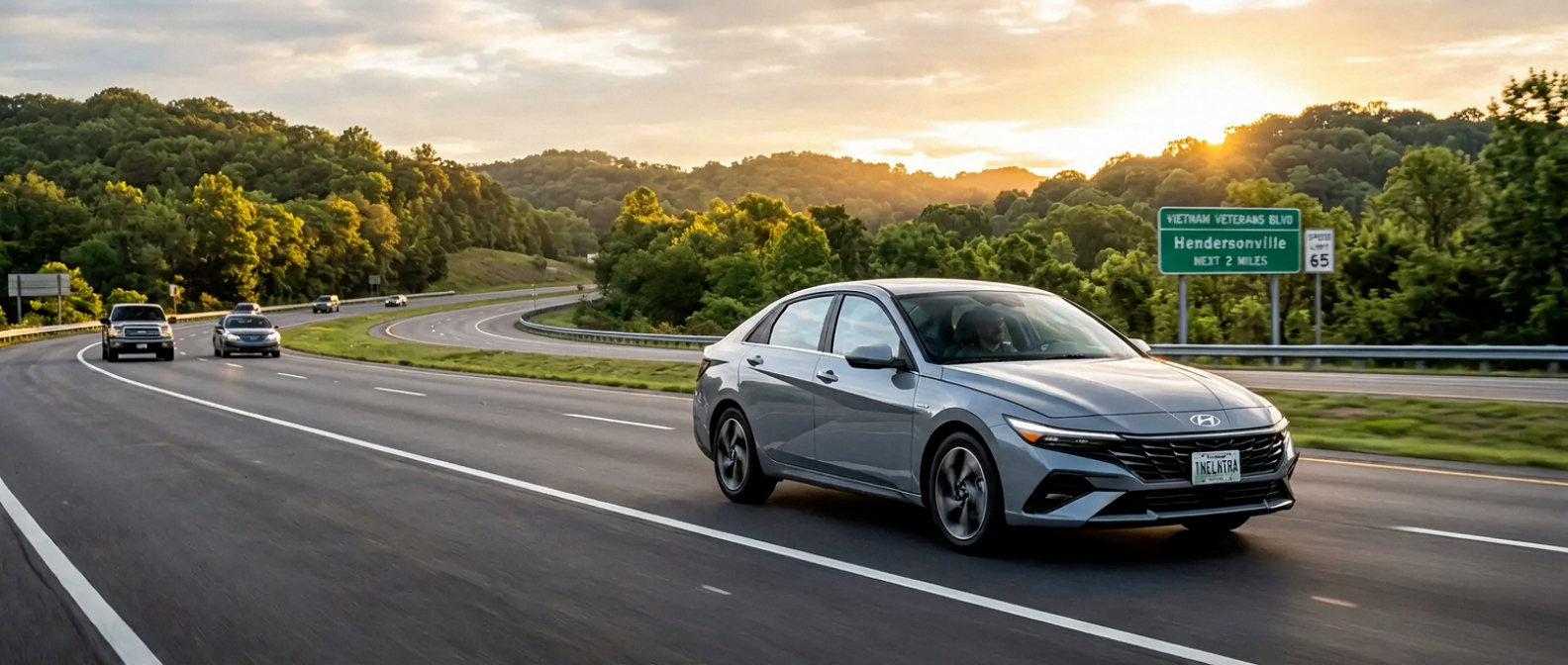
If your whole commute is highway miles on SR-386, the Elantra Hybrid still wins on efficiency, but its advantage runs narrower than the headline numbers suggest. Knowing exactly how narrow helps you make the right call.
The short version
- The EPA rates the 2026 Elantra Hybrid Blue at 58 MPG highway. The gas SE comes in at 40 MPG highway. The gap is real, but smaller than the city-driving gap (51 vs. 31 MPG).
- SR-386 is a controlled-access 65-70 mph bypass, not stop-and-go. Hybrid systems recover the most energy during deceleration, so a pure highway run captures less of that advantage.
- For Hendersonville commuters who also run errands, pick up kids, or navigate Nashville surface streets, the hybrid's combined efficiency lead (54 vs. 35 MPG) is substantial.
- The gas Elantra is a strong highway car on its own. 40 MPG at highway speed is exceptional for a non-hybrid compact.
- The Elantra Hybrid costs more up front. If your driving is almost exclusively SR-386 miles with very little city, the payoff timeline stretches.
September is a solid month to think this through. Summer heat is easing, the morning commute on Vietnam Veterans Boulevard is busy again after the August lull, and you're staring down another fall and winter of daily Nashville runs. Let's get into the actual numbers.
The 2026 Hyundai Elantra comes in two fundamentally different powertrain flavors, and this is the comparison that matters for this commute. Not trim levels. Powertrains.
What's the Real Difference Between the Gas Elantra and the Hybrid?
The gas Elantra runs a naturally aspirated 2.0-liter four-cylinder making 147 horsepower through a continuously variable transmission, while the Hybrid swaps in a 1.6-liter four paired with an electric motor for 139 combined horsepower and a 6-speed dual-clutch. So the hybrid makes slightly less total output, yet it recovers energy every time you lift off the throttle or slow down.
Regenerative braking behavior is everything here. On a stop-and-go surface road, the hybrid recaptures meaningful energy at every light and builds a big efficiency advantage. On a steady-state 70 mph highway, less deceleration happens, so the recovery loop runs less often.
The EPA figures land like this.
| Spec | 2026 Elantra Gas (SE) | 2026 Elantra Hybrid Blue |
|---|---|---|
| City MPG (EPA est.) | 31 | 51 |
| Highway MPG (EPA est.) | 40 | 58 |
| Combined MPG (EPA est.) | 35 | 54 |
| Engine | 2.0L I4, 147 hp | 1.6L I4 + motor, 139 hp |
| Transmission | CVT | 6-speed dual-clutch |
| Fuel Tank | ~12.4 gal | 11.0 gal |
| City vs. highway gap (hybrid advantage) | (20 MPG city, 18 MPG highway) | (20 MPG city, 18 MPG highway) |
The city gap is 20 MPG. The highway gap is 18 MPG. Not as different as they look from the combined numbers. For a driver whose commute is nearly all SR-386 freeway miles, that's the number that matters.
On a pure highway commute, the Elantra Hybrid's advantage narrows from 20 MPG (city) to 18 MPG (highway) over the gas model. Still real, but SR-386's 65-70 mph controlled-access run captures less hybrid regeneration than a city route would.
Does the Hybrid Make Sense for an SR-386 Commuter Specifically?
For an SR-386 commuter specifically, the hybrid still makes sense on pure efficiency, but it collects less of its advantage on this road than it would in town, so the case stays real yet narrower. SR-386, locally known as Vietnam Veterans Boulevard, is a four-lane controlled-access bypass that runs 17-plus miles from I-65 in Goodlettsville east toward Gallatin, with Hendersonville sitting right along its path. The posted limit starts at 70 mph in Davidson County and drops to 65 mph at the Sumner County line. There's no significant grade. No repeated traffic signals. It's purpose-built for sustained highway-speed travel.
The sportier Elantra N is a completely different story for this conversation, but for commuters, a steady 65-70 mph cruise is not the scenario where a hybrid earns its biggest advantage. The advantage compresses on the open road compared with surface streets.
Here's how the math plays out for a typical Hendersonville commute. The average one-way trip for a Hendersonville resident runs around 26 minutes. If your whole route is SR-386 freeway driving, you're logging primarily highway miles. Run the EPA's highway estimate against that.
| Scenario | Gas Elantra SE | Elantra Hybrid Blue |
|---|---|---|
| Approximate 26-min daily one-way range | ~17-18 highway miles | ~17-18 highway miles |
| Highway MPG (EPA est.) | 40 | 58 |
| Fill-up frequency (at highway mix, full tank) | Longer intervals on a 12.4-gal tank | Longer intervals on an 11.0-gal tank |
| Where the hybrid really pays | Secondary city driving added | Mixed commute with errands and Nashville runs |
The honest answer runs like this. If you're all SR-386, all the time, the hybrid is still more efficient. It still wins every row. But the financial case for spending more up front is tighter than it would be for someone who mixes in Nashville surface streets, school pickup loops, or weekend errand runs around Hendersonville. Add those stop-and-go miles and the hybrid advantage grows fast, because that's where regenerative braking runs constantly and the city gap (20 MPG) comes into full effect.
Our finance team can walk you through how the numbers look over a typical ownership period for your specific annual mileage.
What the Gas Elantra Gets Right on the Highway
The gas Elantra earns its keep on the highway, where its EPA-estimated 40 MPG is exceptional for a naturally aspirated compact sedan with no electrification at all, even if it gives up ground the moment your day turns into city miles. Don't dismiss it just because it skips the hybrid badge. The 40 is not a compromise number. At a steady highway cruise, 40 MPG means you're filling up infrequently, and the gas Elantra's roughly 12.4-gallon tank gives it a range that comfortably handles a full week of SR-386 round trips without anxiety.
The CVT keeps the engine in its efficiency sweet spot at highway speed. Hyundai tuned this powertrain for exactly this kind of steady highway pattern.
The downside is real, though. The moment your day turns into more than a straight highway shot, the gas Elantra's city efficiency (31 MPG) lags the hybrid significantly. If Tuesdays mean school pickup in Hendersonville, a Costco run, and an evening drive into Nashville, the gas model starts giving up a lot of that weekly efficiency advantage. None of that knocks the car. It's just how internal combustion engines work. They pull less efficiency at low speeds and in stop-and-go conditions than at a steady cruise.
Team note: We've had shoppers call their commute "all highway" and then walk through a week that includes several surface-street trips adding real city miles. The EPA's 55% city / 45% highway test split lands close to what a realistic mixed driver sees. If your actual split skews heavier highway than 55/45, the gas Elantra makes a stronger case than the combined numbers suggest. And if you're closer to 50/50 or more city-heavy, the hybrid's case gets much stronger.
So Which Elantra Should You Pick for This Commute?
Pick the Elantra that matches your real week, because the choice here comes down to your driving pattern rather than to which car is "better" on paper. If your miles are almost all SR-386, the gas SE fits cleanly. If your week mixes in city driving, the Hybrid pulls ahead.
| Buyer Profile | Best Fit |
|---|---|
| Pure SR-386 commuter, minimal city driving | Gas Elantra SE (40 MPG hwy, lower up-front cost) |
| Mixed: SR-386 plus Nashville surface streets or errands | Elantra Hybrid (54 combined, city advantage kicks in) |
| Commuter who also handles family logistics | Elantra Hybrid (stop-and-go is where it compounds) |
| Want simplicity, longer range, no powertrain complexity | Gas Elantra (no hybrid system to consider, larger tank) |
| Prioritizing lowest per-mile fuel cost over full ownership | Elantra Hybrid Blue (58 hwy, 51 city) |
If your week genuinely skews toward sustained SR-386 highway driving with very little else, the gas Elantra SE is a smart, efficient car and not a significant sacrifice. Forty MPG at highway speed is real. If you add city miles, school runs, or regular Nashville surface-street driving, the Elantra Hybrid starts pulling away fast. The combined EPA estimate of 54 MPG for the Hybrid Blue versus 35 MPG for the gas SE reflects a realistic mixed driving week, and that 19-MPG gap is the number a realistic mixed week actually delivers.
City miles are easy to underestimate when you picture the commute as one long highway shot. Keep that in mind.
Browse our Elantra inventory to see what's on the lot right now, and come in and tell us your real weekly driving pattern. We'll point you at the right powertrain.
Frequently Asked Questions
Is the Elantra Hybrid worth it if I mostly drive on the highway?
Yes, but with an honest caveat. The EPA rates the 2026 Elantra Hybrid Blue at 58 MPG highway versus 40 MPG for the gas Elantra SE. The 18-MPG highway gap is meaningful. But hybrid systems recover the most energy through regenerative braking during deceleration, which happens far less on a controlled-access highway like SR-386 than on city streets. If your commute's truly all highway miles and very little city driving, the Elantra Hybrid is still more efficient, though the financial advantage builds more slowly than it would for a driver with a mixed city-and-highway pattern. Add any city driving to your week and the hybrid's advantage grows substantially.
Does the 2026 Elantra Hybrid require any special charging or maintenance?
No. The 2026 Elantra Hybrid is a self-charging hybrid, meaning it recharges its battery through regenerative braking and the engine as you drive. There's no plug, no home charging equipment to buy, and no charging schedule to manage. From a daily-use standpoint, you fuel it at any gas station exactly like the standard Elantra. The powertrain does add some complexity compared to the gas model, but for a Hendersonville commuter, the ownership experience is straightforward.
Categories:
Social


