

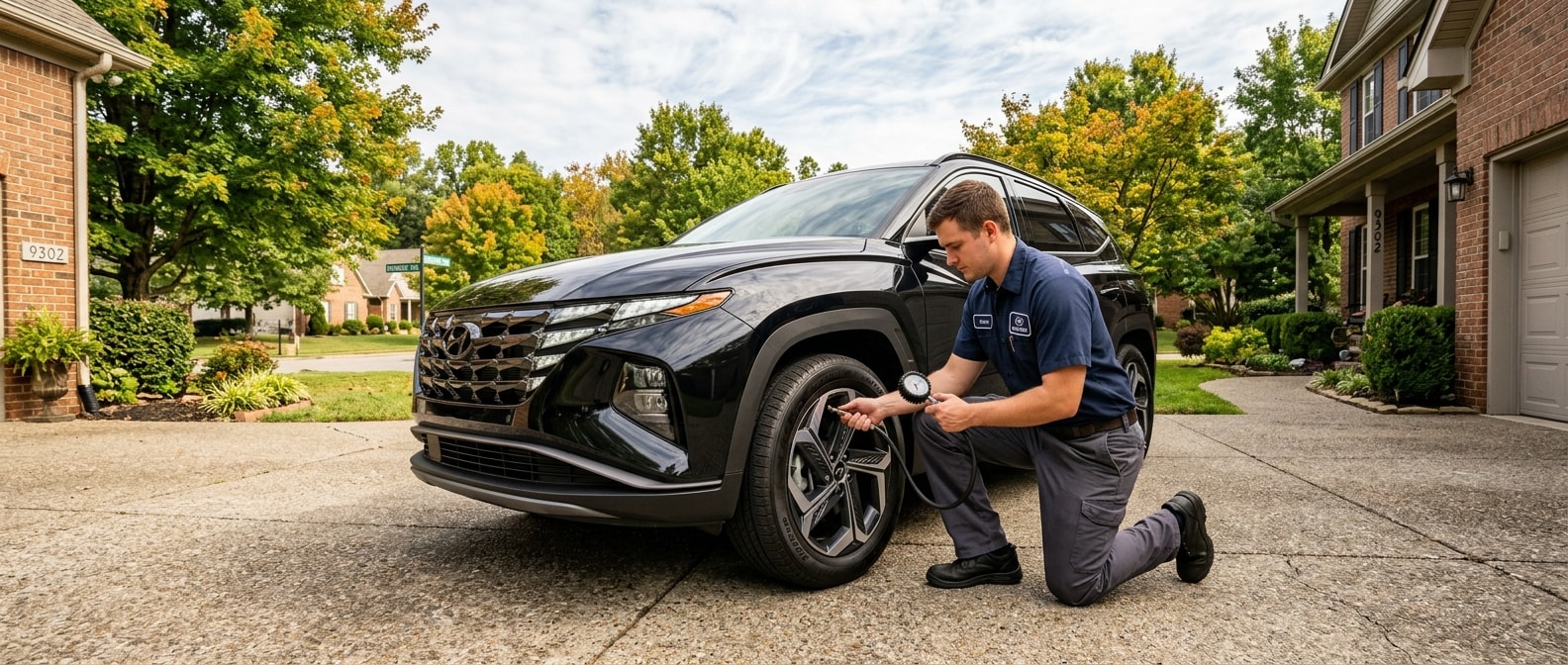
Outside it's 81 degrees, the A/C is still running, and your Hyundai drives perfectly fine. So when someone mentions fall maintenance, the natural reaction runs something like "Fall? It barely feels like September." We hear that in our service lane, and we get it. But that comfortable, late-summer Hendersonville warmth is exactly why this month is the most important service window of the year. Summer's heat damage has already piled up. September is when you catch it before the first cold snap turns it into a roadside problem.
The Hyundai Tucson is one of the vehicles we see most in our bays this time of year, and the owners tend to share the same three misconceptions. Those myths leave vehicles on the road with components one cold morning away from failing.
- September in Hendersonville averages 81 degrees F highs and 62 degrees F lows. That 20-degree daily swing is what exposes everything summer already weakened.
- The 3,000-mile oil change rule is outdated. Modern Hyundai engines on full synthetic go 7,500 to 10,000 miles between changes per manufacturer guidance.
- Your tire pressure warning light does not replace a manual pressure check. It only activates at 25% below the placard pressure, which is already well into the problem zone.
- Summer heat damages car batteries through electrolyte evaporation and internal sulfation. The failure appears weeks or months later in cooler weather, not in August.
- September is the window between "summer damage is done" and "cold weather makes it costly." Act now.
Is the "Wait for Cold Weather" Fall Maintenance Advice Actually True?
No, and it's the most expensive misconception on this list, because by the time November's chill arrives in Hendersonville, a heat-stressed battery or a chronically underinflated tire has stopped being a maintenance item and turned into a breakdown waiting for one cool morning to finish the job. The useful service window is right now, precisely because the weather stays warm enough to reveal what summer actually did.
The local transition shows up in real numbers. Historical climate data for Hendersonville puts September's average high at 81.1 degrees F and average low at 62.2 degrees F. That roughly 20-degree daily swing is the trigger. A battery that held together under three months of 90-degree engine-compartment heat has already lost cold-cranking capacity you can't feel at 62 degrees F. You'll feel it at 32.
| Myth | What's Actually True | Authority |
|---|---|---|
| "It's still warm, fall maintenance can wait until November" | Hendersonville September nights already average 62 degrees F. Heat damage accumulates all summer; this is when it becomes detectable and fixable. | Historical climate data (weather-atlas.com) |
| "Change your oil every 3,000 miles" | Modern Hyundai engines with full synthetic oil are rated for 7,500-10,000 mile intervals under normal driving conditions. | Hyundai manufacturer guidance (owner's manual) |
| "My tire pressure light is off, so my tires are fine" | Per NHTSA specifications, the TPMS warning light only activates at 25% below the placard pressure. Tire pressure also drops roughly 1 PSI for every 10 degrees F decrease in temperature. | NHTSA TPMS mandate; tire pressure physics |
| "My battery is only a few years old, it's probably fine" | AAA reports average battery lifespan is 3 to 5 years, and summer heat accelerates degradation through electrolyte evaporation and sulfation of battery plates. | AAA roadside service data |
| "I checked tire pressure in July, so I'm good" | Correct summer pressure can read 2 to 3 PSI low when morning temperatures drop 20 to 25 degrees, well below the TPMS trigger threshold. | Tire pressure physics (1 PSI per 10 degrees F) |
What These Myths Actually Cost You on the Daily Commute
The practical stakes land on your daily drive, where a 25-to-30-minute commute is the everyday reality for plenty of Hendersonville families, and each of these three myths has a concrete effect on that drive, from the oil you're paying for to the grip you feel on a highway merge.
The Hyundai Santa Fe runs a modern turbocharged GDI engine designed specifically for full synthetic oil at longer intervals. Hyundai's manufacturer guidance for normal driving conditions puts that interval at 7,500 to 10,000 miles. Run oil changes every 3,000 miles on a commuter schedule and the engine gains no extra protection. You just spend more time and money on service it doesn't need that often. The exception is severe conditions (frequent cold starts under five miles, extended towing, or extended idling in stop-and-go traffic). Your owner's manual breaks down which category applies to you.
Tire pressure is trickier, and this is where the TPMS myth causes the most day-to-day wear. NHTSA requires TPMS lights to trigger at 25% below the placard pressure on your driver-side door jamb. On a tire spec'd at 35 PSI, the light comes on at roughly 26 PSI. Well before that, at 32 or 33 PSI, you're already getting accelerated shoulder wear and reduced lateral stability. The 1-PSI-per-10-degrees-F relationship means a tire inflated perfectly on an 85-degree July afternoon loses 2 to 3 PSI once September mornings drop into the low 60s. No light. Just faster wear and less responsive handling on your next highway merge.
The battery situation is the one our team finds most consistent with what shows up when vehicles come in for fall service. Heat speeds the internal chemistry of a 12-volt lead-acid battery in two specific ways. First, electrolyte fluid evaporates, exposing the lead plates to air and causing permanent oxidation. Second, sulfation sets in, where lead sulfate crystals that normally dissolve during charge cycles harden on the plates in extreme heat and block the flow of electricity. Neither process announces itself in August. Both turn up in October or November, on a 38-degree morning, as a very slow crank or no start at all.
Three more September checks that tend to get overlooked:
- Cabin air filter: The A/C has been running at full demand since May. A clogged cabin filter cuts heater airflow and leaves a musty smell the first time you switch from cooling to heat.
- Coolant concentration: If the system took any top-offs with straight water over summer, the freeze-protection concentration may be diluted. A quick test takes minutes.
- Wiper blades: Summer UV degrades rubber a little at a time. A dry August means you might not notice until the first heavy Tennessee fall rain makes it obvious.
Book Your September Hyundai Service Check
So What Should You Actually Do This Month?
Three decisions carry the month for a Hendersonville commuter, and a short list makes it doable, covering the tire check, the battery test, and the oil interval, each one a few minutes of work before the first cold morning asks anything of your Hyundai.
1. Check tire pressure against the door jamb, not the sidewall and not the warning light. The placard on your driver-side door jamb gives the correct cold pressure for your specific vehicle. The number on the tire sidewall is the structural maximum, not your target. Check pressure cold, before the first mile of driving. If you're 2 to 3 PSI low, add air. Five minutes, real payoff in tread life and handling.
2. Get a battery load test, not just a voltage check. A voltage check can read 12.6 volts on a battery that can't sustain a load. A load test measures cold-cranking amps under actual demand conditions. That's the number that matters on a 32-degree morning. If your battery is nearing the three-year mark and has weathered Tennessee summers, the load test is worth a stop before the cold weather hands you a different kind of deadline.
3. Confirm your actual oil change interval for your engine and commute pattern. If your daily round trip is a typical Nashville-suburb drive (25 to 30 miles on a mix of surface roads and highway), you're almost certainly in the "normal driving" category where Hyundai's 7,500-to-10,000-mile synthetic interval applies. Tucson Hybrid and Santa Fe Hybrid owners, confirm the 12-volt auxiliary battery, separate from the hybrid traction battery, gets tested at your next service visit too. It runs the accessories and the starter circuit, and it ages on the same summer heat schedule as any other 12-volt battery.
The honest September list for Hendersonville isn't complicated. Each item's doing real work before the season that'll ask for it.
Frequently Asked Questions
Does Hyundai really recommend oil changes less often than every 3,000 miles?
For modern Hyundai engines running full synthetic oil under normal driving conditions, manufacturer guidance puts the interval at 7,500 to 10,000 miles. The 3,000-mile schedule made sense when engines ran conventional oil and had less refined manufacturing tolerances. Today's Hyundai 2.5L and turbocharged GDI engines are built around longer synthetic intervals. Severe conditions (frequent short trips under five miles, towing, extended stop-and-go idling) can shorten that window. Your owner's manual spells out the exact interval for your model and engine, and our service advisors can confirm whether your commute counts as normal or severe.
How do I know if my Hyundai's battery was damaged by summer heat?
Often you can't tell on a warm morning, which is exactly the problem. Summer heat degrades 12-volt lead-acid batteries through electrolyte evaporation and sulfation of the battery plates, and that damage trims cold-cranking capacity a little at a time rather than all at once. Watch for slower-than-usual cranking, brief flickering of warning lights on startup, or accessories feeling a touch sluggish right at ignition. AAA data puts average battery lifespan at three to five years, and sustained summer heat speeds that curve along. If your battery's nearing three years old and has been through Middle Tennessee summers, a proper load test before the first cold morning is the right call.


