


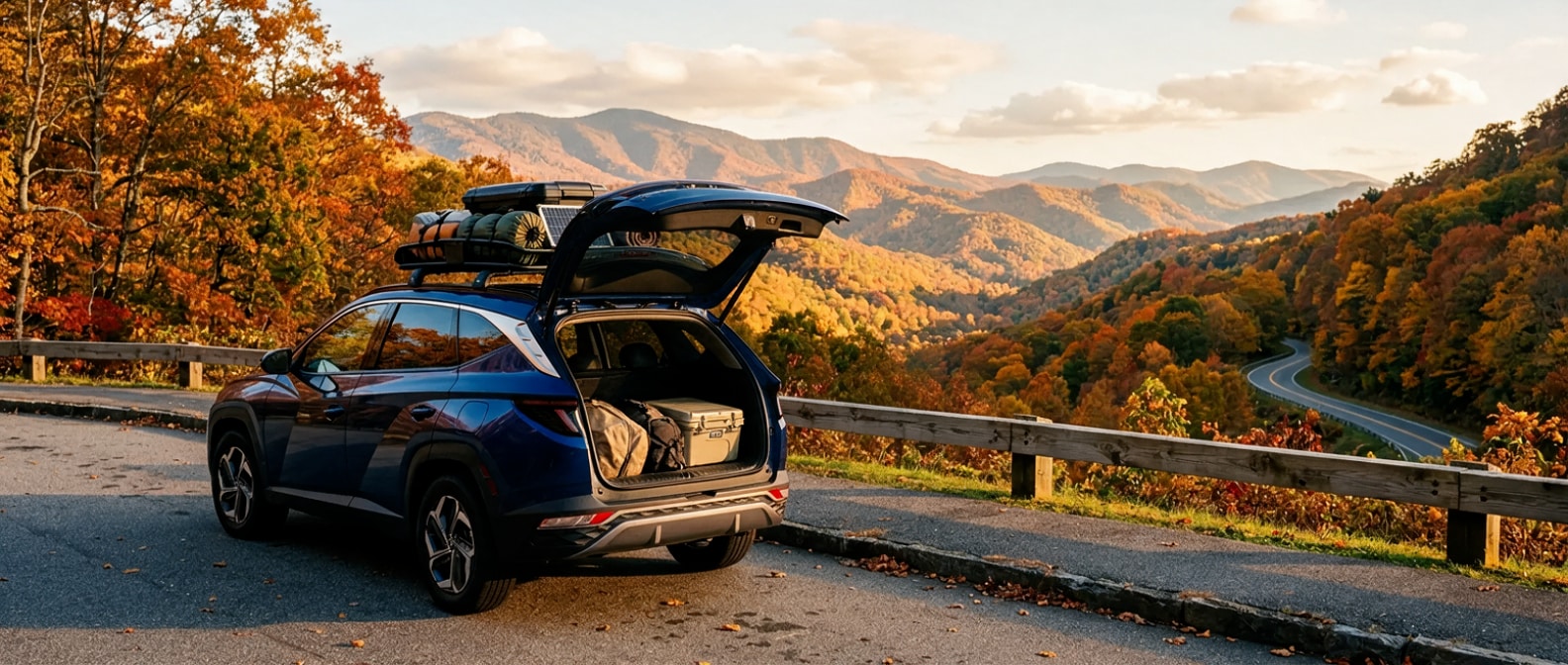
Before a fall trip, a fair question is whether the Rogue really beats the Tucson on highway mpg. On paper that claim isn't wrong. It's just incomplete, and incomplete information leads to the wrong choice for a three-hour run up to the Smokies loaded with your family and their gear.
The fuller story is that the 2026 Hyundai Tucson gives you a powertrain choice the Rogue simply doesn't offer. Pick the standard gas model, and yes, the Rogue edges ahead on combined fuel economy. Choose the Tucson Hybrid, and the equation flips the other way. Not by a little.
Whether you're planning a fall color drive through the Cumberland Plateau or a longer trip south toward Great Smoky Mountains National Park, that distinction shapes the comparison in ways a side-by-side spec sheet doesn't surface.
The short version
- Myth: The Nissan Rogue beats the Hyundai Tucson on fuel economy for road trips.
- Reality: The gas-only Tucson trails the Rogue, but the Tucson Hybrid's EPA-estimated 38 mpg combined surpasses the Rogue's 32 mpg combined by a significant margin.
- Myth: The Rogue has noticeably more cargo room for trip gear.
- Reality: Behind the rear seats, the Tucson Hybrid actually offers more usable space (38.7 cu ft) than the Rogue (36.3 cu ft), and the Hyundai's floor-level battery packaging keeps every cubic foot accessible.
- Bottom line: For Nashville-area families doing real fall road trips, the Tucson Hybrid is the smarter trip SUV. The gas Tucson and the Rogue are genuinely close, and which you prefer comes down to how you weigh highway feel against storage flexibility.
Browse 2026 Hyundai Tucson inventory at Hallmark Hyundai Hendersonville to see current trims and colors in stock.
Is the Rogue Actually More Fuel-Efficient Than the Tucson?
Whether the Rogue really is more efficient depends entirely on which Tucson you set beside it, since the Rogue FWD earns an EPA-estimated 29 city, 36 highway, and 32 combined while the gas-only 2026 Tucson FWD comes in at 25 city, 33 highway, and 28 combined. That first pairing is real, and it truly is strong for a non-hybrid compact SUV. On that comparison alone, the Rogue wins.
But Hyundai also builds a hybrid version. That changes everything.
| Claim | What's Actually True |
|---|---|
| "The Rogue gets better highway mpg than the Tucson" | True vs. the gas Tucson (36 vs. 33 hwy EPA). False vs. the Tucson Hybrid (37 hwy EPA for AWD, 38 for FWD base trim). |
| "The Rogue has more cargo space" | False. The Tucson Hybrid offers 38.7 cu ft behind the rear seats; the Rogue offers 36.3 cu ft. Maximum folded capacity is nearly identical (74.1 vs. 74.5 cu ft). |
| "The Tucson is underpowered compared to the Rogue" | False for the Hybrid. The Tucson Hybrid's 1.6L turbo paired with an electric motor produces 231 combined hp, versus the Rogue's 201 hp from its 1.5L three-cylinder. |
| "Both SUVs are roughly the same on the highway" | Partially true at equal trim. But the Rogue has no hybrid option; the Tucson Hybrid delivers 38 mpg combined with no trade-off in cargo capacity. |
| "The Rogue is better for families because it has more rear legroom" | True. The Rogue offers 38.5 inches of rear legroom; the Tucson Hybrid's rear seat measures 41.3 inches, actually giving it the advantage here. |
| "You can't tow much with either of them" | Partially true. Rogue's max tow rating is 1,500 lbs. The gas Tucson rates up to 2,750 lbs with trailer brakes. |
The EPA rates the 2026 Hyundai Tucson Hybrid at 38 city and 38 highway on its base Blue SE trim. A flat, same-on-both-ends efficiency figure like that is one most SUVs don't hit even on the highway alone. For a fall drive that mixes two-lane switchbacks through the Cumberland Plateau with interstate stretches, regenerative braking during descents keeps the hybrid system working for you the whole way.
See Tucson Hybrid trims and availability to compare the Blue SE and SEL specs side by side.
What These Numbers Actually Mean on a Tennessee Fall Road Trip
Fall in Middle Tennessee means the Natchez Trace Parkway runs gorgeous and slow, the Foothills Parkway toward the Smokies gets narrow in spots, and I-40 east can pack serious traffic near Cookeville and Crossville, so the numbers only matter once you map them onto that route. These aren't abstract driving conditions. They're the real route profile that separates a road-trip SUV from a commuter that happens to have a liftgate.
Hendersonville is in Sumner County, Tennessee.
Regenerative braking is where the Tucson Hybrid earns its keep on a route like this. Every descent from a ridge on the Cumberland Plateau, every long downhill into a river valley, puts charge back into the battery. There's real physics behind it. It's the functional reason hybrid systems can outperform their EPA combined ratings on routes with elevation change, and it's why we think the rated 38 mpg holds up well on Tennessee fall drives compared with a pure-highway flat-road run.
The 2026 Tucson Hybrid packages its battery underneath the cabin floor, so cargo volume stays the same as the gas model: 38.7 cubic feet behind the rear seats, with a dual-level floor for hiding valuables or fitting taller items.
The Rogue is no slouch as a road-trip SUV, and we'll say that plainly. Its cabin stays notably quiet at highway speeds, the Divide-N-Hide cargo system makes clever use of floor space, and ProPILOT Assist on upper trims takes real fatigue out of a long interstate stretch. If your family spends most of its miles on the highway and rarely meets elevation, the Rogue's 36 mpg highway on FWD trims is real and competitive.
There's an honest tradeoff on the Rogue. It has no hybrid option this model year, and its tow rating tops out at 1,500 lbs. If you're pulling a small camper or a utility trailer for fall outdoor gear, that rating matters. The Tucson gas model handles up to 2,750 lbs with trailer brakes installed, Hyundai confirms.
"The 2026 Nissan Rogue earns 2025 IIHS Top Safety Pick with enhanced crash protection." (Nissan USA press release, October 2025)
Both vehicles carry solid safety credentials. NHTSA gave the Rogue a 5-star overall rating. Standard forward collision-avoidance assist, lane keeping assist, and driver attention warning arrive on every Tucson trim from SE up, per Hyundai.
Safety won't be your deciding factor here.
See Current Offers on the 2026 Tucson
So Which One Should You Actually Drive Off the Lot?
It comes down to one question, whether you want a hybrid powertrain, and that single choice decides almost everything else about how these two SUVs compare on a fall trip out of Hendersonville, from fuel economy to cargo to the way each one handles a mountain descent.
If yes, the Tucson Hybrid is the clear pick. Nothing in the Rogue lineup matches 38 mpg combined with 231 hp, 38.7 cubic feet of cargo space that no floor-mounted battery has eaten into, and a 41.3-inch rear seat for whoever ends up in back. On SEL and above trims, the Tucson Hybrid's standard AWD adds real grip for Tennessee fall driving on wet leaves and early-season mountain roads.
If you'd rather stay gas-only, the comparison is genuinely close. The Rogue edges the gas Tucson on combined fuel economy (32 vs. 28 mpg combined), while the Tucson answers back on cargo volume behind the rear seats (38.7 vs. 36.3 cu ft) and on tow capacity. On SL and above trims, the Rogue's ProPILOT Assist is a real highway comfort feature. Over on the Hyundai side, the XRT trim adds Terrain Mode with Mud, Sand, and Snow settings, worth something on early October mountain mornings when the road surface is unpredictable.
Our team's take is grounded in the terrain more than anything. The Foothills Parkway and the Natchez Trace throw exactly the descents and elevation change that reward the Tucson Hybrid's regenerative system every fall, in a way a flat commuter route never will. If you're going to put real miles on a fall trip and you have the option to choose a hybrid, that's the Tucson Hybrid's strongest argument.
Compare Tucson Hybrid trims here before you make your decision. If you're weighing a larger family hauler for fall adventures, the 2026 Hyundai Santa Fe is worth a look too.
Frequently Asked Questions
Does the 2026 Hyundai Tucson Hybrid get better gas mileage than the 2026 Nissan Rogue on the highway?
Yes. The EPA rates the 2026 Tucson Hybrid at 38 mpg highway on its base Blue SE trim and 37 mpg highway on AWD trims, compared to the Rogue FWD's 36 mpg highway and Rogue AWD's 35 mpg highway. For a fall road trip with elevation changes, the Tucson Hybrid's regenerative braking during descents can help sustain that efficiency in real driving conditions.
Which has more cargo space for road trip gear: the 2026 Tucson or the 2026 Nissan Rogue?
The 2026 Hyundai Tucson Hybrid has more cargo room behind the rear seats: 38.7 cubic feet versus the Rogue's 36.3 cubic feet. Maximum capacity with the rear seats folded is nearly identical (74.5 cu ft for the Tucson Hybrid vs. 74.1 cu ft for the Rogue). Hyundai packages the Tucson Hybrid's battery underneath the cabin floor, so it does not reduce usable cargo space compared to the gas model.
Categories:
Social


