


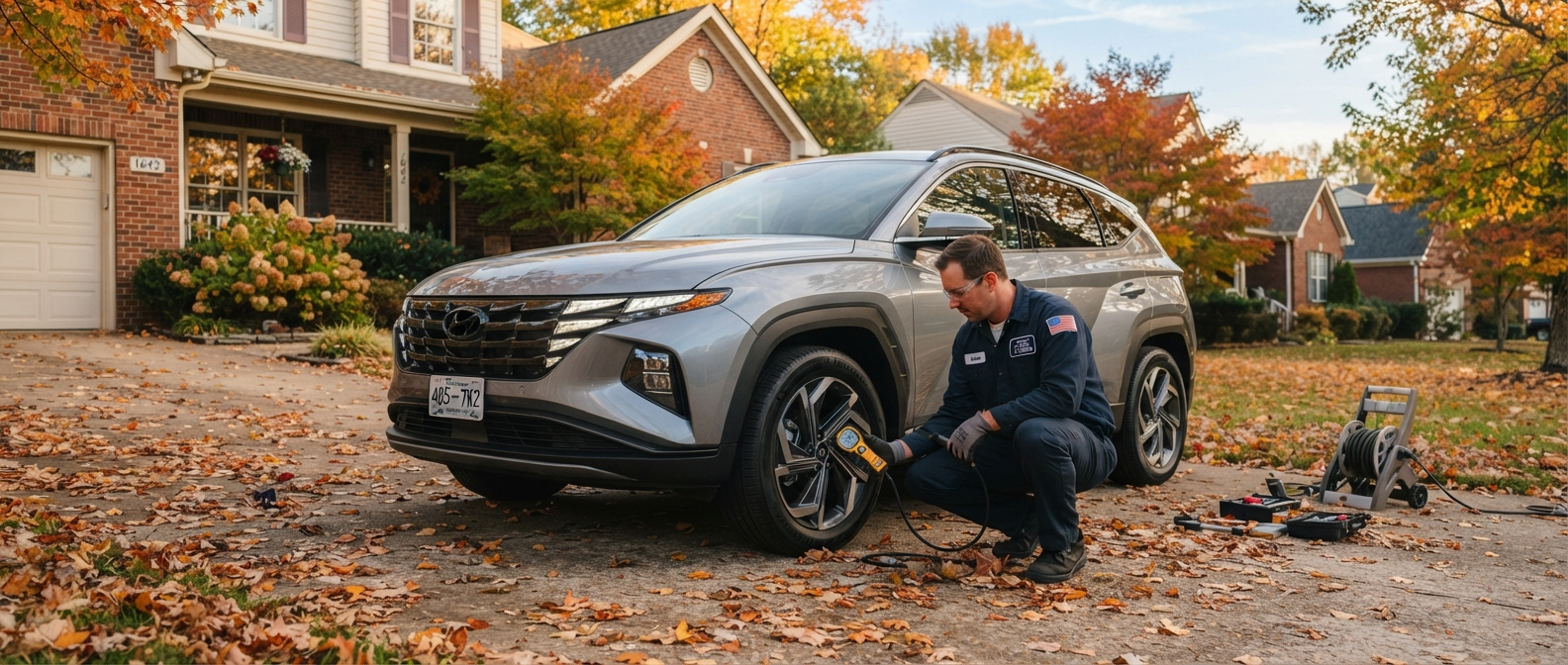
October in Hendersonville treats your vehicle gently. The weather stays pleasant enough that nothing feels urgent, and that's exactly why the most expensive maintenance mistakes get made this month.
Drivers fall into a predictable trap, and our service team watches it play out on a real and recurring pattern. A Tucson survives a brutal July and August without complaint, so October feels like coasting. What you can't feel is three months of engine-compartment heat quietly degrading your battery's cold-cranking capacity, while your tire pressure drifts down by roughly 1 PSI for every 10-degree drop in temperature. By December, those two quiet problems turn into a no-start morning and a handling surprise on a rain-slicked commute.
The good news is that October is the fix window. Act now, while it's still easy.
The short version
- Your TPMS light is not a "tires are fine" signal. Per NHTSA's standard, it only activates when pressure is already 25% below the placard spec. That's problem territory, not heads-up territory.
- Modern Hyundai engines with full synthetic oil are manufacturer-rated for 7,500 miles under normal conditions. The old 3,000-mile rule is a relic.
- Heat kills batteries first; cold just finishes the job. Summer is the damage season, and October is when that damage becomes detectable and fixable before it strands you.
- Tennessee's October temperature swings (daily highs near 70 degrees Fahrenheit, overnight lows in the mid-40s) drop tire pressure by 2-3 PSI across a single day. That's not a tire problem. That's physics.
- Coolant doesn't need flushing at every fall service, but it does need a level and freeze-point check, because degraded coolant is invisible until it fails.
We cover a lot of ground below, and the short version is simple. October isn't a "wait and see" month. October sits in the window between "summer did its damage" and "cold weather makes you pay for it." Our Tucson drivers feel it most, because a 25-30 mile commute day puts those temperature swings to work twice over.
Are These October Maintenance Beliefs Actually True?
Mostly no, though not every one of these beliefs is pure fiction, so we've laid out the full picture myth by myth below, pairing each claim Hendersonville drivers make with the verified reality and the source standing behind it.
| The Claim Hendersonville Drivers Make | What's Actually True | Authority |
|---|---|---|
| "If my TPMS light isn't on, my tire pressure is fine." | The NHTSA-mandated warning threshold is 25% below placard pressure. Already deep into the problem zone before the light activates. A tire spec'd at 35 PSI doesn't trigger the light until ~26 PSI. | NHTSA FMVSS No. 138 |
| "I'll wait until winter to get my battery checked." | Heat is what degrades a car battery, not cold. Summer temperatures cause electrolyte loss and internal sulfation. Cold weather reveals that damage weeks or months later. October, not November, is the useful service window. | AAA, industry battery research |
| "My Hyundai needs an oil change every 3,000 miles." | Hyundai's manufacturer-published normal-service interval for current models using full synthetic oil is 7,500 miles or 12 months. Turbocharged engines (Tucson 1.6T, Elantra N) call for 5,000-6,000 miles. The 3,000-mile rule predates synthetic oil and modern engine tolerances. | Hyundai owner's manual guidance |
| "Tennessee fall doesn't really affect tire pressure." | Temperature data for Hendersonville shows daily highs near 70 degrees Fahrenheit and overnight lows around 44-50 degrees Fahrenheit in late October, a 25 degree Fahrenheit swing. Tire pressure drops approximately 1 PSI per 10 degrees Fahrenheit of temperature change. That's a 2-3 PSI variance across a single day. | Physics / Weather-Atlas Hendersonville climate data |
| "New Hyundais have long-life coolant. I don't need to touch it." | True and false. Hyundai long-life coolant has an initial service interval of 120,000 miles or 10 years. But it still needs a visual level check and a freeze-point inspection each fall, because a low level or degraded mix won't protect against the cold nights that are already here. | Hyundai service documentation |
| "All-season tires mean I'm set for whatever Tennessee winter brings." | All-season tires handle Middle Tennessee's occasional ice and light snow adequately for most drivers, though adequate and optimal are two different things. Compound matters: below 45 degrees Fahrenheit, all-season rubber stiffens. For drivers making regular mountain or rural runs, the conversation is worth having. | NHTSA tire research |
What October's Temperature Swing Is Actually Doing to Your Car Right Now
Hendersonville's late October climate works on your car in two concrete ways, and while the daytime weather still feels mild enough to ignore, the overnight end of the daily swing is where the damage hides, and it's already building toward a January problem. Weather data puts average highs around 69-73 degrees Fahrenheit and overnight lows between 44 and 50 degrees Fahrenheit, a daily swing of roughly 25 degrees, and that's a bigger gap than it feels.
If you own a Tucson Hybrid or Santa Fe Hybrid, your hybrid system's 12-volt auxiliary battery serves a different function than the traction battery, but it's still a conventional lead-acid unit exposed to the same temperature cycling. Our team recommends a load test (not just a voltage check) for any battery past the three-year mark, because voltage looks fine on a warm afternoon and shows its real capacity on a cold morning.
Tires. The 1-PSI-per-10-degree-Fahrenheit rule is real physics, and it holds almost exactly. A tire inflated to spec at noon around 70 degrees Fahrenheit can read 2-3 PSI low at 6 a.m. when it's near 45 degrees Fahrenheit. No slow leak is involved. Temperature physics does it, every night, right now. Your door jamb carries the placard spec your Hyundai was designed for. Check pressure cold, in the morning, before you've driven, with an actual gauge. Treat the TPMS light as a backup, not your reference point.
Per NHTSA's Federal Motor Vehicle Safety Standard No. 138, your tire pressure warning light is required to activate when pressure falls 25% or more below the manufacturer's recommended cold inflation pressure, which is already well into the problem zone by the time it lights up.
Battery. A load test in October costs very little time, and it catches a battery that voltage-checks fine but can't actually deliver cold-cranking amps under demand. We're talking about the battery that starts your Sonata Hybrid at 68 degrees Fahrenheit every morning and then refuses at 29 degrees Fahrenheit in January.
Schedule Your Fall Multi-Point Inspection
The 3,000-Mile Oil Myth Deserves Its Own Section
The 3,000-mile interval earned its reputation decades ago and no longer fits most current Hyundais, because it was built for conventional oil in older engine designs and simply doesn't track with what full synthetic does in a modern engine, though checking in a little early never hurts anything. We still write service tickets for drivers who are sure they're overdue.
Hyundai's published normal-service interval for non-turbo engines, the Elantra, Kona, naturally aspirated Tucson and Santa Fe, Palisade base, is 7,500 miles or 12 months, whichever comes first, using the specified full synthetic oil. Turbocharged variants, including the Tucson 1.6T Hybrid, Santa Fe 1.6T Hybrid, and Elantra N, run a bit tighter at 5,000-6,000 miles under normal conditions. The severe-service schedule, which covers frequent short trips under 5 miles, regular stop-and-go, and towing, trims those intervals further. If you're a Hendersonville commuter doing mostly highway miles into Nashville, you're almost certainly on the normal schedule.
Weigh the honest tradeoff before you move your appointment up. Checking in early is never wrong, and changing oil at 4,000 miles when your Tucson calls for 7,500 won't harm the engine. It just spends money that could stay in your pocket. The risk runs the other way. A driver who's convinced "every 5,000 miles" is the right interval for their Elantra N's 2.0T is stretching a turbocharged engine's oil longer than the manufacturer intends.
"Hyundai recommends engine oil and filter changes every 7,500 miles or 12 months under normal driving conditions using 0W-20 full synthetic oil that meets API SP or ILSAC GF-6 specifications." . Hyundai 2026 Tucson owner's manual guidance
Elantra N owners should pay particular attention here. Turbo engines put more thermal stress on oil, and you'll want to treat the 5,000-6,000-mile interval as the right number for normal duty.
So What Should You Actually Do This October?
The action list for a Hendersonville Hyundai driver right now is short and specific, and it won't eat your whole morning, so you can knock out the four things that matter this month without over-servicing the car or waiting until the cold weather forces your hand.
Check tire pressure this week. Do it cold, in the morning, before driving, against the door-jamb spec for your exact trim. Every trim can have a different placard pressure. Skip the TPMS as your reference and trust the gauge. And make a note to recheck as temperatures continue dropping through November.
Request a battery load test by name. When you schedule service, ask for a "load test" by name. A multi-point inspection often includes a voltage check, and voltage and load-test results aren't the same data point. A voltage check at 12.6V can read healthy while the same battery fails under the demand of a cold start. Our service team runs both.
Verify your oil interval against your actual driving pattern. If you've crossed the 7,500-mile mark or it's been 12 months since your last change, you're due. If you fit the severe-service definition, meaning short daily trips, lots of stop-and-go, and regular towing, your interval is tighter. Ask our team to walk you through where you fall.
Get a coolant level and freeze-point check. Ask for the check rather than a flush. Unless you've already passed the 120,000-mile/10-year service interval for coolant replacement on your Hyundai, a visual level inspection and a freeze-point test with a refractometer is what the job calls for this October.
Book your October service appointment online, and we'll run all of the above in one visit. Plan on a single morning slot, not a day-long commitment.
Frequently Asked Questions
Does my TPMS light coming on mean I need new tires?
Not necessarily. Your tire pressure warning light activates at 25% below the placard pressure, per NHTSA's FMVSS No. 138 standard. That means it's triggered by underinflation, which can result from temperature drops, a slow leak, or a nail, not only by worn tires. When the light comes on, check the pressure on all four tires against the door-jamb spec and look for a puncture. Tire replacement is a separate decision based on tread depth (the wear bars sit at 2/32 of an inch) and sidewall condition. Our service team measures both during a multi-point inspection.
How do I know if my Hyundai is on the normal or severe oil change schedule?
Hyundai's owner's manual lists both schedules. The severe schedule applies if your regular driving includes frequent trips under 5 miles (engine doesn't fully warm up), heavy stop-and-go traffic, towing or hauling, or sustained operation in extreme temperatures. Many Hendersonville drivers who commute longer distances on mostly open road fall into the normal schedule, which is 7,500 miles or 12 months for full synthetic oil on non-turbo engines. If you're not sure, our service advisors can walk through your driving pattern and tell you exactly which interval applies to your Hyundai and engine.
Categories:
Social


