


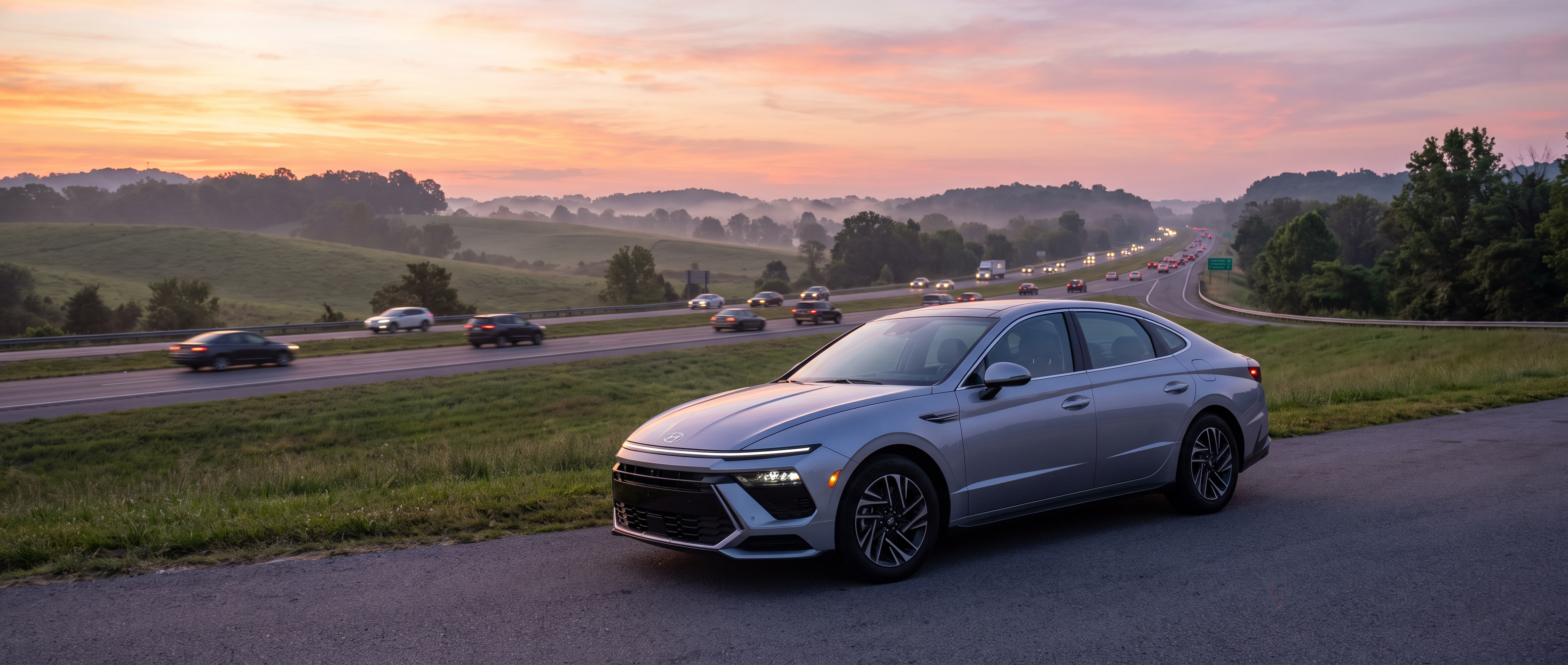
The commute from Hendersonville to Nashville plays right into the Sonata Hybrid's strengths. Its stop-and-go stretches actually help the powertrain. Bottom line, if you're driving Vietnam Veterans Boulevard to I-65 South five days a week, the Sonata Hybrid's powertrain is built for exactly that pattern, and the fuel savings are real, compounding, and easy to quantify.
The 2026 Hyundai Sonata Hybrid earns an EPA-estimated 47 city / 56 highway / 51 combined mpg in Blue trim. The EPA tests that figure against a 55% city / 45% highway cycle, so it's no best-case number buried in fine print. Your Sumner County drive, with its traffic signals on Vietnam Veterans Boulevard and its merging onto I-65 in morning rush, maps to that exact mix.
Will This Commute Route Really Squeeze Out the Savings?
Yes, this route truly squeezes out the savings, with one caveat worth stating up front, because the hybrid earns most of its efficiency in the stop-and-go sections of your drive, not on the wide-open highway legs, and that's worth understanding before you run any math on your own commute. The mechanism deserves a minute of your time.
The Sonata Hybrid uses a 2.0-liter four-cylinder paired with an electric motor, outputting a combined 192 horsepower and paired to a conventional 6-speed automatic transmission (not a CVT, a detail worth asking about). Every time you slow for the traffic signal clusters on Vietnam Veterans Boulevard or ease off the throttle as you merge onto I-65, the electric motor flips into generator mode. Regenerative braking takes the kinetic energy a gas-only car would vent as heat through the brake pads, converts it back into electrical energy, and stores it in the battery. When you accelerate again, the system pulls on that stored charge to ease the load on the gas engine.
Stop-and-go traffic recaptures energy. A pure highway run at 70 mph, by contrast, gives the hybrid battery almost nothing to recover.
| Commute Scenario | Driving Condition | Estimated Efficiency | Fits Sonata Hybrid? |
|---|---|---|---|
| Vietnam Veterans Blvd (SR-386) inbound | Stop-and-go, 40-55 mph, traffic signals | Meets or exceeds EPA city 47 mpg (Blue) | Strong fit |
| I-65 South merge and cruise | Moderate highway, 55-65 mph in congestion | Sustained hybrid assist, near EPA combined | Strong fit |
| Full open highway at 70+ mph | Light traffic, steady throttle | Electric assist reduced; approaches gas-engine load | Moderate fit |
| Cold-weather mornings (below 35 F) | Engine runs more for cabin heat | Expect 5-8 mpg reduction vs. EPA estimates | Plan for it |
| Round-trip daily commute (50-60 miles) | Mixed urban/highway per TN commute data | 13.2-gallon tank gives roughly 600+ miles range | Fill once every 10-12 days |
The EPA rates the Blue trim at 47 mpg city and 56 mpg highway. Step up to the SEL and Limited and the numbers read 44 mpg city and 51 mpg highway, since they carry more equipment and weigh about 248 pounds more than the Blue. The added weight explains the whole gap, nothing more exotic than that. Same engine, same battery, just more equipment to carry.
See Current Sonata Hybrid Offers
How to Think About the Three Trims for a Commuter
For a commuter, the trim choice comes down to a real tradeoff, and both sides hold up well, because the Blue trim wrings out the most miles per gallon while the SEL and Limited give back a few of those mpg in exchange for cabin comfort you'll feel on a 45-minute drive. Neither answer is wrong.
The Blue trim is the efficiency champion. It runs narrower 205/65 R16 tires with lower rolling resistance, and its lighter curb weight (3,439 pounds per the Hyundai specification) means the electric motor and gas engine do less work per mile. If your commute is your primary use case, the Blue's 51 combined mpg is the number to chase.
Step up to the SEL and Limited and you add heated front seats, a panoramic sunroof, and (on the Limited) a navigation-integrated 12.3-inch display and ventilated front seats. They land at 47 combined mpg, still an exceptional number. Here's the honest read, if you spend 45 minutes each way in that cabin and you want ventilated seats for a Tennessee August or heated seats for a January morning on I-65, the SEL or Limited makes a genuine quality-of-life case for a commuter, well beyond the spec sheet.
For customers who can't decide, we put it this way. The commute savings are real at every trim, so the question is whether you'd rather maximize the savings or the comfort for the time you spend in the car. Both are defensible answers.
What Smart Cruise Control actually does on I-65. All three Sonata Hybrid trims come standard with Hyundai SmartSense, including Smart Cruise Control with Stop and Go. On I-65 South during morning rush, the system holds your following distance and brings the car to a full stop in traffic without you touching the pedals, then accelerates smoothly when the lane opens. Smoother acceleration from a stop lets the hybrid system draw more cleanly on electric power instead of forcing the gas engine in hard, which keeps your real-world mpg close to the EPA estimate.
The standard Sonata (non-hybrid) is worth a mention here for context. Its EPA-estimated 32 combined mpg on the SE trim is solid for a midsize sedan, but on a 50-mile-a-day round trip, the gap between 32 mpg and 51 mpg adds up in a way that's truly worth calculating. Run the numbers first.
Steps to Calculate Your Actual Sumner County Savings
You can pin down your real savings in a few minutes using your own numbers, and the result will lean on your specific route as much as the window sticker, so the steps below take you from your actual commute miles to a figure you can trust. No guesswork, no rounding up.
- Nail down your annual mileage. Measure your one-way commute from your Hendersonville address to your Nashville workplace using Google Maps or a drive odometer. Double it, then multiply by roughly 250 working days. Add your weekend driving. You've got your annual mileage baseline.
- Find the current Tennessee average gas price. The AAA fuel gauge for Tennessee updates daily and hands you a real regional number instead of a national average.
- Run the math for 51 mpg (Blue) vs. your current vehicle. Divide your annual miles by each mpg figure, then multiply by the price per gallon. The difference is your projected annual fuel savings.
- Factor in cold months. Tennessee winters are mild but not uniform. On mornings when temperatures drop below 35 F, the Sonata Hybrid's gas engine runs longer to heat the cabin, which trims efficiency. Hyundai's hybrid system is calibrated to handle it, but your December-through-February numbers will run a few mpg below the EPA rating. Plan for that stretch.
- Account for the regenerative braking dividend. If your commute leans on Vietnam Veterans Boulevard stop-and-go more than open I-65 cruising, your city mpg can realistically meet or slightly edge past the EPA city estimate. The hybrid earns in traffic, and it's the sustained 70-mph highway leg where it behaves more like a conventional engine.
- Revisit the trim math. Once you have your annual fuel cost at 51 mpg (Blue) and at 47 mpg (SEL/Limited), you know the exact efficiency premium you'd trade for the added cabin features. Now you've got a real number to weigh against your comfort priorities, instead of a vague "it's a little less efficient."
The Job Done: What Sumner County Commuters Actually Get
What a Sumner County commuter gets is a sedan that sips fuel and stretches the gap between fill-ups, with one honest tradeoff on cargo worth naming before you buy, and the range numbers set the stage: a 13.2-gallon tank at 51 combined mpg in the Blue trim produces a theoretical range of roughly 673 miles. On a typical 50-to-60-mile daily round trip, that works out to roughly 11 or 12 days between fill-ups, so a commute like this means filling up about twice a month, give or take a cold snap.
The tradeoff worth naming plainly is cargo. The Sonata Hybrid's hybrid battery lives under the trunk floor, which trims cargo volume to 15.1 cubic feet. A gas-only midsize sedan usually offers 16 cubic feet or more. If you're hauling serious gear on the regular, not just commuter bags but actual cargo, the Hyundai Santa Fe Hybrid gives you crossover cargo room with a hybrid powertrain. But for a commuter running Sumner County routes in a 40-to-50-minute window, 15.1 cubic feet is plenty, and the fuel calculus tips decisively toward the sedan.
On the Hendersonville-to-Nashville commutes we talk through at the dealership, the Sonata Hybrid earns its value in the miles driven, while the cargo bay is where it asks a small compromise. If the back seat is your main passenger haul and the trunk handles briefcases and grocery runs, this car fits without compromise.
Want that efficiency to carry into a weekend mountain run toward the Cumberland region? It does. The SEL and Limited trims add the creature comforts that make a 2-hour road trip enjoyable without giving up a meaningful efficiency edge at highway speeds.
The job's done here. Every spec in this breakdown comes from EPA and Hyundai's published figures, and every commute-route detail reflects verified traffic data for the Hendersonville-to-Nashville corridor.
Categories:
Social


