

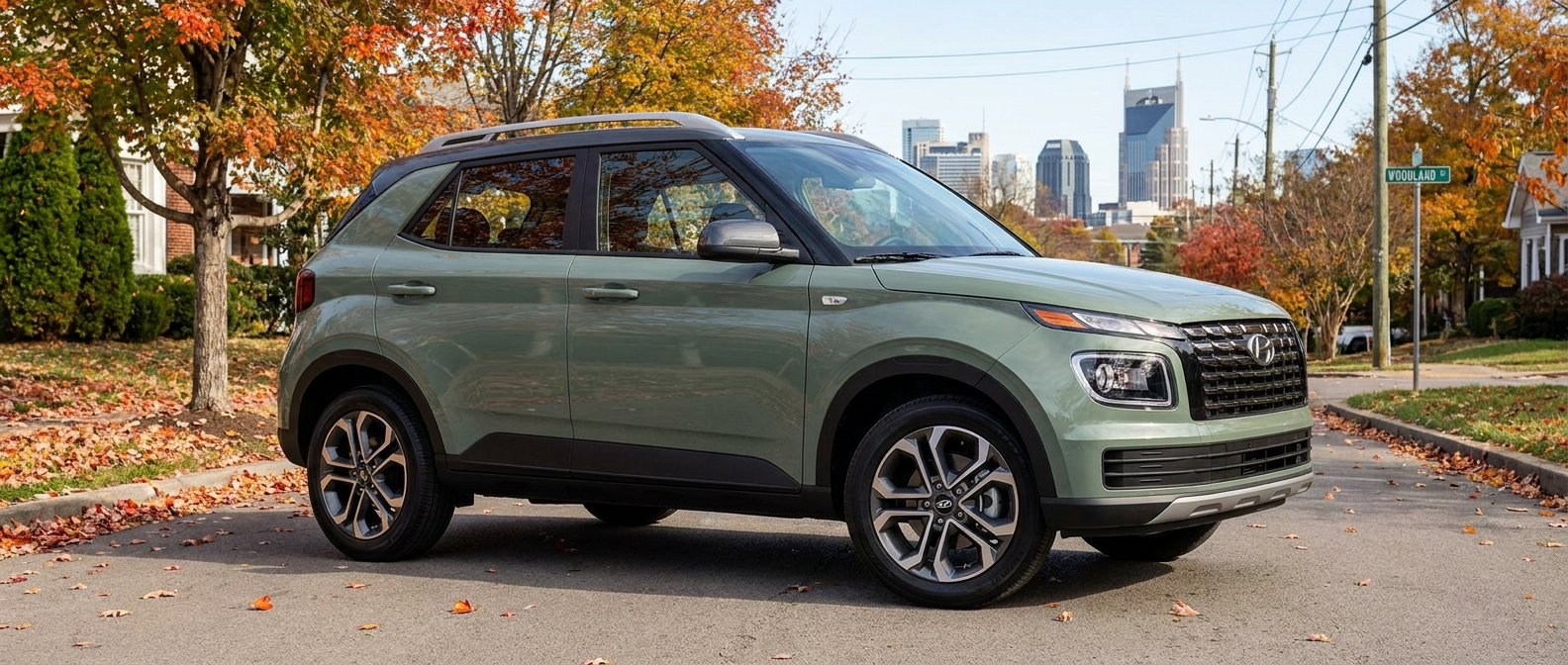
If you're a young driver in Madison or anywhere along the Hendersonville commute corridor, the 2026 Hyundai Venue already makes plenty of sense on paper. It's compact enough to thread into tight campus or apartment parking, the EPA rates it at 31 mpg combined, and every trim ships with a genuine driver-assistance suite out of the box. The question isn't whether the Venue works for this life stage. It's which version of it.
The call really splits two ways. For some buyers the SE is the right pick, and for others the SEL earns its keep. The gap between them runs deeper than a feature list. What separates them is what you meet on SR-386 at 7:45 in the morning.
Browse our 2026 Hyundai Venue inventory to see what's in stock while you read through the breakdown below.
- For the budget-first young driver: The SE delivers wireless Apple CarPlay, forward collision avoidance, lane-keeping assist, and a rearview camera as standard. A genuine safety net for the money.
- For the Nashville commuter doing lane changes on I-65 or SR-386: The SEL adds blind-spot monitoring and rear cross-traffic alert. On a busy interstate corridor, those two features change the daily experience.
- For the young driver who wants the full package: The SEL also brings push-button start, wireless charging, heated front seats, and Drive Mode Select, with a Snow setting included.
- The honest tradeoff for everyone: No all-wheel drive is available on the Venue at any trim. Middle Tennessee winters are mild, but when ice comes, it comes on those interchange ramps. Know that going in.
- Bottom line: If your daily drive involves regular highway lane changes, the SEL earns its price difference. If you're mostly on surface streets and value keeping costs down, the SE doesn't shortchange you on safety essentials.
What Actually Matters When Choosing Between the SE and SEL?
For a young driver the SE and SEL divide along three practical lines, and both cover the safety core, but the SEL reaches further on highway gear, so the right pick comes down to how much interstate driving your week holds and how much comfort tech you want. Weigh the safety features you'll use every single day, the comfort equipment that makes a 30-minute commute tolerable, and the one structural limitation both trims share. Hyundai's spec sheet is clear on all three.
| Feature | SE | SEL | Why It Matters for Young Drivers |
|---|---|---|---|
| Forward Collision-Avoidance Assist w/ Pedestrian Detection | Standard | Standard | Active braking in stop-and-go on Gallatin Pike or SR-386 |
| Lane Keeping Assist | Standard | Standard | Keeps you in your lane during fatigue-prone morning runs |
| Driver Attention Warning | Standard | Standard | Monitors drowsiness. Relevant for early commutes |
| Blind-Spot Collision Warning | Not available | Standard | The biggest functional gap between the two trims |
| Rear Cross-Traffic Collision Warning | Not available | Standard | Tight apartment parking lots, busy strip-mall exits |
| Wireless Apple CarPlay / Android Auto | Standard | Standard | Navigation, music, calls without plugging in |
| Wireless Phone Charging | Not available | Standard | Keeps your phone alive on the commute |
| Heated Front Seats | Not available | Standard | Tennessee winters are short, but January mornings are real |
| Push-Button Start | Not available | Standard | Convenience that adds up daily |
| Drive Mode Select (Normal/Snow/Sport) | Not available | Standard | Snow mode on ice-prone interstate ramps |
| Rear Disc Brakes | Drum | Disc | Shorter stopping distances, especially under repeated braking |
| Wheel Size | 15-inch alloy | 17-inch alloy | Larger contact patch, slightly more grip |
| AWD Available | No | No | Honest limitation either way |
The NHTSA gave the 2026 Venue an overall 4-star safety rating, with a 5-star result in side crash testing. Both trims share that structure.
The Safety Stack: Where the SE Holds Its Ground and Where the SEL Pulls Ahead
The SE's standard SmartSense package is more substantive than its price position suggests, and that's the piece a young driver can easily underestimate, because the active safety tech on the base trim does real work rather than sitting there as a spec-sheet checkbox. Forward Collision-Avoidance Assist does more than warn you. The system can apply the brakes on its own when it detects a collision. Lane Keeping Assist goes past a beep and feeds in steering correction to bring you back toward center. Driver Attention Warning watches your inputs and flags you when fatigue patterns show up. None of that is window dressing.
One structural difference matters to us here. The SEL swaps the SE's drum rear brakes for disc brakes, and under repeated braking in stop-and-go traffic, drum brakes fade faster than discs. On most days that gap is small, though it's a real one.
Check current Venue availability in both trims
Matching the Venue to How Young Drivers Actually Use It in This Market
The 31 mpg combined figure matters in practical terms for this commute. Madison sits roughly 15 to 22 minutes from downtown Nashville in normal traffic on Gallatin Pike, and Hendersonville to downtown runs 25 to 35 minutes via SR-386 and I-65. A young driver doing that round trip five days a week covers real ground. On an 11.9-gallon tank at 31 mpg combined, the Venue has a real-world range of around 370 miles per tank, so you're refueling every week and a half rather than every few days, and that adds up over a year.
The Venue's 159.1-inch length (shorter than most subcompact crossovers in this class) and a 33.2-foot curb-to-curb turning radius make it notably easy to manage in the apartment complexes and dense strip-mall parking that define suburban Nashville driving. A longer car doesn't necessarily feel harder to drive until you're trying to reverse out of a diagonal spot between two pickups. The Venue doesn't create that problem.
The tradeoff we name plainly for every shopper is the structural one. There's no all-wheel drive option on the 2026 Venue, not on the SE and not on the SEL. Middle Tennessee doesn't get prolonged winters, but interstate exchange ramps and bridge decks can ice over fast. If you're a young driver who regularly heads north toward Gallatin or makes early-morning commutes in January or February, give that real thought. Our take runs like this. If winter traction is a priority, the Hyundai Kona is the next step up and does offer AWD. If your commute is mostly surface streets and you drive carefully in bad weather, the Venue's FWD handles Tennessee winters adequately for most situations.
How to Match the Trim to Your Actual Drive
The SE is the smarter pick for a surface-street commute around Madison or Inglewood, and it keeps your out-of-pocket cost as low as possible while still carrying the full SmartSense suite, so you hold the line on budget without giving up the active safety tech that matters most in everyday driving. That full suite is the reason the base trim never feels stripped.
The SEL earns the price difference if your daily route puts you on SR-386, I-65, or any other multi-lane highway where lane changes are routine. On those roads, blind-spot monitoring stops being a luxury and becomes the tool you reach for every time you move over. The Drive Mode Select system's Snow setting also gives you a meaningful calibration option when weather turns. And if you're the kind of driver who forgets to plug in your phone until it's at 8%, wireless charging is a quality-of-life feature that sounds minor until you use it every day.
Explore financing options to see what works for your situation, whether you're choosing SE or SEL.
One last note from our team. For 2026, Hyundai folded the former Limited trim's features directly into the SEL, so the SEL is meaningfully better-equipped than it was in prior years. In 2026 that leaves the SEL a stronger value proposition than at any point before.
Frequently Asked Questions
Is the 2026 Hyundai Venue a good first car for a young driver in the Nashville area?
For a young driver in the Nashville commuter belt, the 2026 Venue makes a well-suited first car. At 159.1 inches it's short enough to park in tight spots, the EPA rates it at 31 mpg combined, and every trim includes Hyundai's SmartSense suite with forward collision avoidance, lane-keeping assist, and driver attention warning as standard. The honest limitation is no all-wheel drive at any trim level, which matters on icy bridge decks and highway ramps during Tennessee winter events. For a driver who stays mostly on surface streets, the SE covers the essentials. For one doing regular highway commutes with lane changes, the SEL's blind-spot monitoring is worth the step up.
What does the Hyundai Venue SEL add over the SE for a young driver?
For a young driver, the SEL's most meaningful upgrades are blind-spot collision warning, rear cross-traffic alert, rear disc brakes in place of the SE's drum setup, push-button start, wireless phone charging, heated front seats, and Drive Mode Select with a Snow setting. The SEL also adds 17-inch alloy wheels versus the SE's 15-inch units. Both trims share the same 1.6-liter engine, CVT, EPA-rated fuel economy of 29 city / 33 highway / 31 combined, and the core SmartSense driver-assistance package.


