

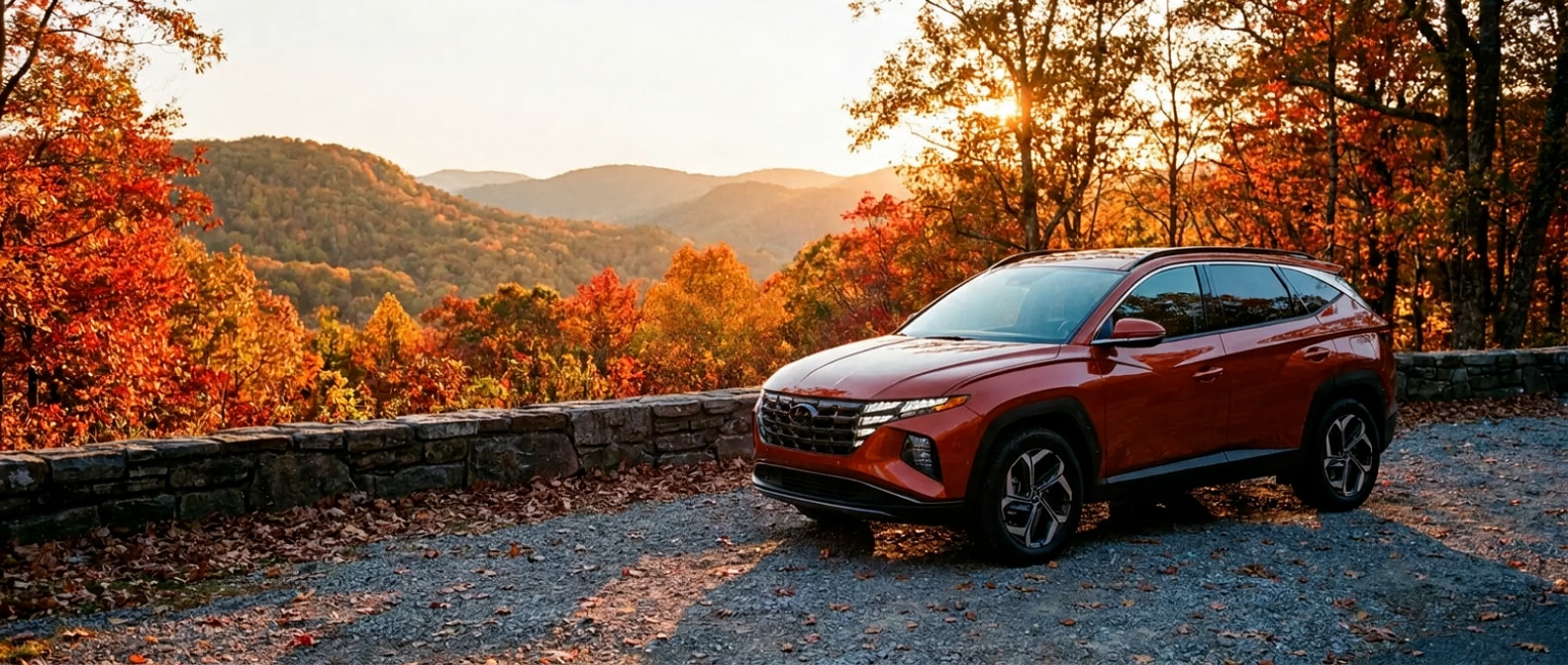
Go with the 2026 Tucson Hybrid if your fall drives are mostly Hendersonville-to-Nashville with a Cumberland Plateau weekend or two mixed in. The 2026 Outback earns the nod when you're making those plateau runs regularly, towing a camper, or you genuinely need extra ground clearance on unimproved overlook pulloffs.
The short version
- The 2026 Hyundai Tucson Hybrid delivers an EPA-estimated 36 mpg combined with AWD standard, making it the fuel-efficiency winner for the commuter who also chases fall color.
- The 2026 Subaru Outback comes with 8.7 inches of ground clearance and symmetrical AWD on every single trim, no upgrade required; that half-inch over the Tucson matters on wet leaf-covered gravel pulloffs.
- Cargo behind the rear seats: Outback at 34.6 cu ft, Tucson (gas and hybrid) at 38.7 cu ft. The Tucson actually wins here.
- Tennessee's Cumberland Plateau peaks mid-to-late October 2026, per East Tennessee State University's fall color report. You're reading this at exactly the right time.
- Bottom line: daily Hendersonville commuter who takes fall trips, buy the Tucson Hybrid. Weekend adventurer who tows and trails, buy the Outback.
Planning a drive from the Tucson Hybrid up to the Cumberland Plateau this October? We wrote this comparison for you. A lot of Tucson-versus-Outback write-ups size these two up on a generic national scale. We sell Tucson and Tucson Hybrid here at Hallmark Hyundai Hendersonville, so we're the Hyundai side of this conversation. We're also Hendersonville folks who know what I-40 east toward Cookeville looks like on a wet October Saturday. So let's be straight about what the numbers mean for this drive.
What's the Real Difference Between These Two SUVs?
The Outback is the physically bigger vehicle, it rides higher, and it brings AWD on every trim, while the Tucson trades that extra inch of clearance for more cargo room and a hybrid setup that makes your daily commute cheaper to run. Both earn the fall trip, so the split comes down to how you'll spend the other fifty weeks.
Lay them side by side on the axes that matter for Tennessee fall driving and you'll see the split fast.
| Spec | 2026 Hyundai Tucson (AWD Gas) | 2026 Hyundai Tucson Hybrid (AWD) | 2026 Subaru Outback (AWD) |
|---|---|---|---|
| EPA Combined MPG | 26 mpg | 36 mpg | 27 mpg |
| AWD | Optional (HTRAC) | Standard | Standard (Symmetrical) |
| Ground Clearance | 8.3 in | 8.3 in | 8.7 in |
| Cargo (seats up) | 38.7 cu ft | 38.7 cu ft | 34.6 cu ft |
| Horsepower | 187 hp | 231 hp combined | 180 hp |
| Towing (base engine) | 2,750 lb | Not rated for towing | 2,700 lb |
| Length | 182.7 in | 182.7 in | 191.7 in |
The Tucson Hybrid is the efficiency winner by a wide margin. The Outback wins on ground clearance and standard AWD access. Those two facts decide most buyers in this comparison.
Does Ground Clearance Actually Matter on Tennessee Fall Roads?
Ground clearance matters more where you park than where you drive, and for most paved plateau routes it doesn't register, but it earns its keep the moment you pull onto an unimproved overlook. So it comes down to whether your fall stops stay on asphalt or wander onto gravel.
On pavement, even wet-leaf pavement on the plateau climbs east of Cookeville, both vehicles handle the road fine. Eight-point-three inches (the Tucson's clearance) versus 8.7 inches (the Outback's, as Subaru lists it) is not a meaningful gap when you're on a paved two-lane. Where it shows up is at the overlook pulloffs. The ones worth stopping at on the Cumberland Plateau are frequently unpaved, sometimes rutted after rain, and the Outback's extra half-inch of belly clearance combined with its Subaru X-MODE terrain system (standard on the 2026) gives it a real advantage, and not just on paper.
The Cumberland Plateau, where the standard Tucson and its competitors are often tested side by side in October, sits at roughly 1,800 to 2,000 feet of elevation. According to Tennessee State Parks, mid-to-late October is the plateau's peak color window for 2026, and the East Tennessee State University fall color report confirms color was running on track as of early October after a hot, dry September. Right now, in other words, you're planning exactly the kind of drive this comparison is built around.
The Outback's longer wheelbase (108.1 in vs the Tucson's 108.5 in; nearly identical, actually) and its 191.7-inch overall length versus the Tucson's 182.7 inches give it a more planted feel on longer, sweeping plateau curves. You'll feel the extra nine inches of body length in how it tracks through bends, noticeably on a long sweep.
Browse current Tucson and Tucson Hybrid inventory if you want to see what we've got on the lot right now.
Fuel Economy: Where the Tucson Hybrid Changes the Math
Fuel economy is where the Tucson Hybrid pulls clear, and it isn't close, because the EPA rates the 2026 Tucson Hybrid at 36 mpg combined with AWD standard on every trim against the Outback base engine's 27 mpg combined, though the gas Tucson and the Outback land within one mpg of each other. Nine miles per gallon.
On a round trip from Hendersonville to the plateau and back, roughly 150 miles, that gap adds up over a season. But the more important number is your daily commute. If you're doing 25 to 30 miles each way into Nashville or around Sumner County five days a week, the Tucson Hybrid's hybrid system is working for you every single day of the year, not just on fall weekends. The Outback doesn't have a hybrid option in its current lineup.
The standard gas Tucson AWD, rated at 24 city / 30 highway / 26 combined by the EPA, lands just one mpg below the Outback's 25 city / 31 highway / 27 combined. At that point they're essentially tied on efficiency, and the Tucson's extra cargo room and lower curb weight tip the value equation.
Worth noting: If you're cross-shopping gas-only Tucson versus Outback and efficiency is your main lever, the Outback edges ahead on highway mpg (31 vs 30). It's a one-mpg difference and worth acknowledging. The hybrid Tucson blows both out of the water.
See Current Tucson and Tucson Hybrid Offers
Cargo and Practicality for a Fall Weekend Away
Cargo is where this matchup flips, because the Outback doesn't win it, and Hyundai's specs put the 2026 Tucson (gas and hybrid) at 38.7 cubic feet behind the rear seats against the 2026 Outback's 34.6 cubic feet in the same configuration, though the gap nearly closes once both rows fold flat.
Load two adults' worth of overnight gear, hiking boots, and a cooler for a weekend on the plateau, and the difference shows. Fold the Outback's seats flat and it opens up to 80.5 cubic feet of total cargo volume, which beats the Tucson's approximately 80.3 cubic feet at full fold. So for hauling a bike or a full pack of camping gear, they're close to even at maximum. For typical loaded-trunk family driving with seats in use, the Tucson has more usable space.
On the towing front, Hyundai rates the gas Tucson at 2,750 pounds with trailer brakes, and Subaru's specs put the Outback's base engine at 2,700 pounds. Essentially identical. (The Tucson Hybrid isn't rated for towing, a limitation if you're pulling a small camper to a fall campsite.) The Outback's turbocharged XT trims jump to 3,500 pounds of towing capacity, a different category of capability if that matters to you.
So Which Should You Pick?
Pick the Tucson Hybrid if you're commuting daily in the Nashville metro, want AWD without paying extra for it, need more everyday cargo room, and take three or four fall drives a year on paved plateau roads. The 36 mpg combined EPA estimate and 231 combined horsepower make it the right tool for the most common version of this lifestyle.
Pick the Outback if you're regularly on unimproved overlooks or gravel forest roads, want the extra confidence of X-MODE terrain management on challenging surfaces, need to tow more than 2,700 pounds, or simply prefer a longer, more wagon-forward body style. It's a genuinely different vehicle in character. The 8.7 inches of ground clearance and standard AWD on every trim (including the entry-level Premium) mean you don't have to spec up to get the fall-drive capability. No upgrade needed.
The Tucson Hybrid has an honest limitation. If towing or rough-surface trail access is a regular use case, it isn't the right answer. We'll say that plainly. For the commuter who chases fall color a few weekends a year, though, it's hard to beat 36 mpg with all-wheel drive already built in.
Explore financing options for either path, and we can weigh what fits your driving pattern. We'll help you sort it out.
Frequently Asked Questions
Does the Hyundai Tucson have standard AWD for Tennessee fall drives?
AWD on the 2026 Tucson gas model is optional and available on all five trims (SE, SEL, XRT, SEL Premium, and Limited) through Hyundai's HTRAC system. On the Tucson Hybrid, HTRAC AWD is standard across all trim levels. If you want AWD without asking for it as an upgrade, the Tucson Hybrid and any Outback trim both deliver it standard.
Is the Subaru Outback really that much better off-road than the Tucson?
On paved Tennessee mountain roads, including the plateau climbs east of Crossville, the difference is minor. Where it becomes real is on unpaved overlook pulloffs and gravel forest roads. The 2026 Outback's 8.7 inches of ground clearance (versus the Tucson's 8.3 inches on standard trims) combined with its standard X-MODE terrain system give it a practical, not just spec-sheet, advantage on those surfaces. For purely paved fall drives, either vehicle handles the road with ease.
Categories:
Social


