


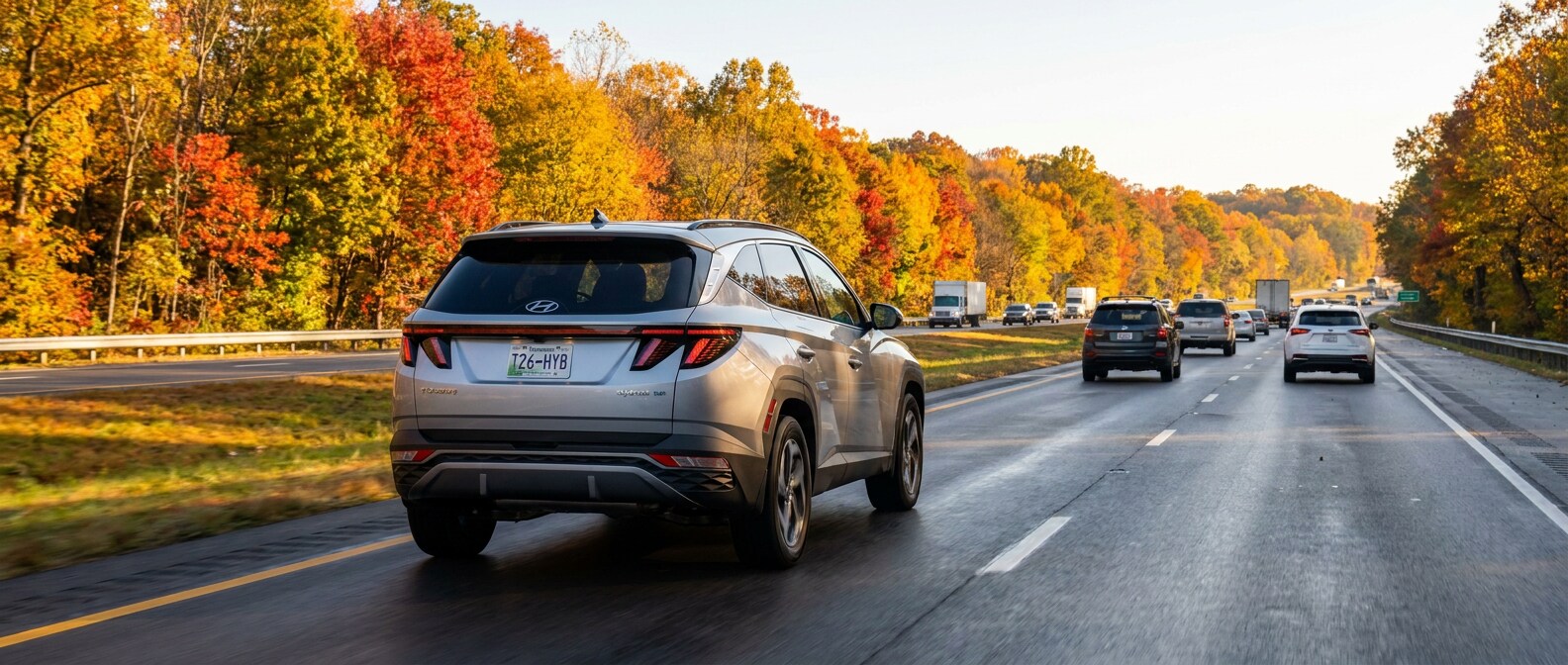
Before you pack the car, let's lay out the value case plainly. The 2026 Hyundai Tucson Hybrid earns an EPA-estimated 38 mpg combined on the Blue SE trim, and the hybrid system does its best work in exactly the kind of stop-and-go holiday traffic you'll hit on I-24 and I-65 heading into Nashville on the Wednesday before Thanksgiving. So the appeal here goes past the daily commute. A clogged road turns it into a road-trip win.
We'll be straight with you about the flip side. If your Thanksgiving drive is a pure 300-mile open-highway haul at 75 mph, the efficiency advantage shrinks. The hybrid system still outperforms a gas Tucson in those conditions, but the gap's narrower than the EPA window sticker suggests. Knowing that before you pick your trim is what this guide is for.
What Do You Actually Get at Each Trim Level?
You get four trims of the 2026 Tucson Hybrid, and the reassuring part is that they share the same mechanical heart, so no trim leaves you short on power or all-weather traction even if you're buying the most affordable one in the lineup. Every one pairs a 1.6-liter turbocharged four-cylinder with an electric motor for 231 combined horsepower, runs through a 6-speed automatic, and comes with all-wheel drive standard. No trim is left without AWD. Where they differ is in features, tech level, and one important efficiency detail.
| Trim | EPA Fuel Economy (City / Hwy / Combined) | Key Standard Features | Who It's For |
|---|---|---|---|
| Blue SE | 38 / 38 / 38 mpg (est.) | 12.3-inch touchscreen, wireless Apple CarPlay and Android Auto, Hyundai SmartSense safety suite, proximity key, AWD | Efficiency-first buyers who want the best MPG number and a genuinely well-equipped base |
| SEL | 37 / 36 / 36 mpg (est.) | Adds heated front seats, 18-inch alloys, roof side rails, hands-free smart liftgate | Commuters who run errands in cold weather and want the creature comforts without the top-tier price |
| SEL Convenience | 37 / 36 / 36 mpg (est.) | Adds 12.3-inch digital instrument cluster, panoramic sunroof, synthetic leather seating, built-in navigation | Families who spend real time in the car and want the dual-screen setup and sunroof for road trips |
| Limited | 37 / 36 / 36 mpg (est.) | Adds Bose audio, premium leather, Highway Driving Assist, Safe Exit Assist, full luxury touches | Buyers who want the flagship experience and are willing to step up to the top of the range |
One thing worth calling out is the gap between the Blue SE's 38/38/38 EPA estimate and the upper trims' 37/36/36. Those smaller 17-inch wheels, versus 18- or 19-inch on higher trims, reduce rolling resistance enough that the EPA registers it. On a purely efficiency-focused Thanksgiving run, the Blue SE is the most efficient Tucson Hybrid you'll find on the lot.
Shopping for more space for the whole family? The Santa Fe Hybrid is also worth a look if you're hauling more people or gear this holiday season.
Why Holiday Traffic Actually Helps This Hybrid (and What to Expect on the Open Road)
Holiday traffic actually helps this hybrid, and that cuts against the usual worry that congestion only burns fuel, because you're recapturing energy through regenerative braking every time you slow down. Stop-and-go driving does more than get tolerated here. Slow traffic is where the system clearly outperforms its own EPA estimate. Tennessee's Thanksgiving travel pattern is well-documented. The Tennessee Department of Transportation identifies I-24 and I-65 north as primary congestion corridors during the holiday, with Wednesday afternoon and early evening being the most compressed travel windows. That kind of crawl-and-brake traffic is precisely where the Tucson Hybrid's electric motor does the most work and the gas engine rests.
What changes above 70 mph? Quite a bit, because the gas engine carries most of the load and the aerodynamic drag increases. Real-world highway efficiency in the 33 to 36 mpg range is a fair expectation for the upper trims at sustained highway speeds, per sources that've tested the vehicle on highway-heavy routes. It still beats the gas Tucson's EPA-estimated 26 mpg combined on AWD. But keep your expectations grounded if your whole drive is a flat-out highway sprint.
The 14-gallon tank at 38 mpg combined gives the Blue SE an EPA-estimated range of roughly 532 miles. Most Thanksgiving drives from Hendersonville fit comfortably within a single tank.
Tip: Cold November temperatures do reduce hybrid battery efficiency somewhat. Warm the cabin with the seat heaters before you leave (they draw less energy than the full HVAC at max heat) and let the system warm up for a few minutes. It's a small adjustment that helps the hybrid battery operate closer to its rated efficiency in cool weather.
| Pros | Cons |
|---|---|
| EPA-estimated 38 mpg combined (Blue SE) in stop-and-go holiday traffic conditions | Highway efficiency at 75+ mph is realistically 33-36 mpg, not the full 38 |
| AWD standard across all trims for wet November roads on I-24 and I-40 | Upper trims (SEL and above) are EPA-rated at 36 mpg combined, not 38 |
| Regenerative braking excels in the holiday congestion where other SUVs burn more fuel | Hybrid system benefit narrows on a pure open-highway run versus mixed driving |
| 14-gallon tank with up to 532-mile estimated range means fewer fuel stops on a long trip | Cold temperatures reduce battery performance somewhat versus warm-weather driving |
| 231 hp means no sluggishness merging onto a packed I-65 on-ramp | Blue SE's smaller 17-inch wheels limit some visual impact versus the SEL's 18s |
See current Tucson Hybrid availability on our lot, and you'll want to do it before the holiday week starts.
The Smart Choice for Hendersonville Families Heading Out for the Holiday
For most Hendersonville families, the smart choice depends on how much of the drive is congested versus wide-open, and the short version is that the hybrid earns its keep on the mixed Middle Tennessee run more than on a pure interstate sprint. If your Thanksgiving travel is the classic Middle Tennessee mix, you already know the shape of it. Surface streets out of Hendersonville, a stretch on I-65 or I-24 through Nashville, then more varied driving once you arrive. On that kind of trip, the Tucson Hybrid earns its efficiency advantage on a meaningful portion, specifically the urban and congested sections, which also tend to eat the most elapsed time even when they're short on miles.
The Blue SE is the right choice if the efficiency number is the priority and you're comfortable with the base feature set, which is genuinely well-equipped. You're not getting a stripped truck. You get a 12.3-inch touchscreen, wireless CarPlay and Android Auto, the full Hyundai SmartSense safety suite, and AWD from the factory. You're getting a capable vehicle right out of the box.
Step up to the SEL if cold mornings on the drive to Nashville have you reaching for heated seats, or if the hands-free liftgate matters with kids and luggage in tow. The SEL Convenience is the one to consider if your family spends significant time in the car, and the panoramic sunroof and dual-screen cabin change how the drive feels. The Limited is the flagship, full stop, and it makes sense for buyers who want the premium experience across the entire vehicle, not just the powertrain.
Here's how we'd frame the money question without quoting a number. The hybrid premium over the gas Tucson pays for itself gradually through fuel costs across normal driving, not in a single Thanksgiving tank. The value case is cumulative. For families who commute 25 or 30 minutes into Nashville five days a week and then take a few longer holiday drives per year, the math over time favors the hybrid. The math just doesn't tilt that way in a single tank.
Not sure if the hybrid version is right for you? The standard Tucson is worth comparing directly on our lot.
View Current Tucson Hybrid Offers
Frequently Asked Questions
Does the Tucson Hybrid really save fuel in heavy Thanksgiving traffic?
Yes, and this is actually where it performs best. The hybrid system uses regenerative braking to recapture energy when you slow down, which is exactly what happens repeatedly in stop-and-go holiday congestion. The gas engine can rest entirely at low speeds and in traffic queues, running primarily on electric power. The EPA rates the 2026 Tucson Hybrid Blue SE at 38 mpg combined, and in genuinely stop-heavy driving some owners report seeing figures at or above that number.
Which Tucson Hybrid trim gets the best fuel economy?
The Blue SE. It's EPA-rated at 38 mpg city / 38 mpg highway / 38 mpg combined, which is 2 combined mpg better than the SEL, SEL Convenience, and Limited trims (all rated 37 city / 36 highway / 36 combined). The difference comes from the Blue SE's smaller 17-inch wheels, which reduce rolling resistance enough to move the efficiency needle. If maximizing the EPA number is your goal, the Blue SE is the one.
Categories:
Social


