


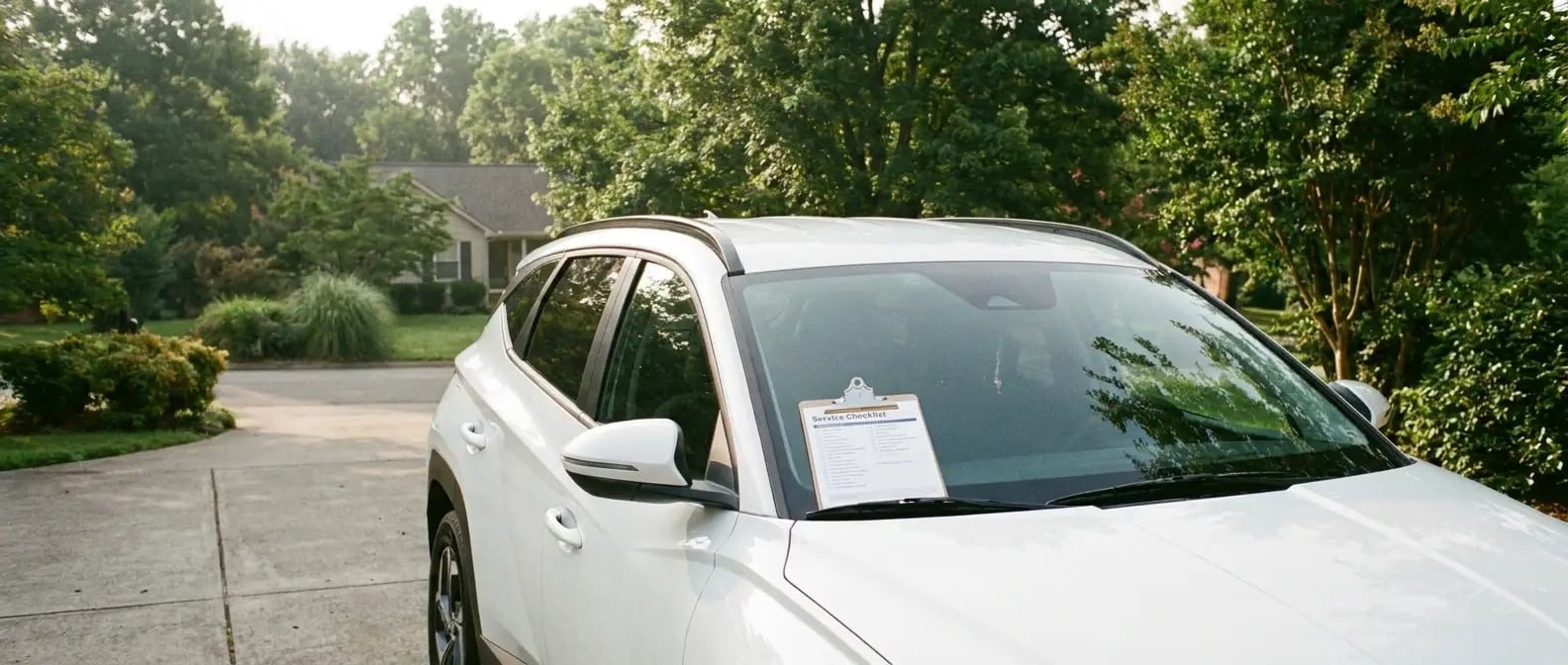
August in Hendersonville is a legitimate stress test. Average highs sit right at 90 degrees, relative humidity runs 70 percent or higher, and if your commute touches I-65 or TN-386 during morning rush hour, Hyundai's own owner's manual classifies that drive as "severe." You're not doing anything wrong. Repeated stop-and-go in high ambient heat genuinely accelerates wear in ways a smooth highway run doesn't. The checklist below is built around what this specific month does to your Hyundai. Run it now, before summer hands you a problem you didn't see coming.
Book a service appointment at Hallmark Hyundai Hendersonville if anything on this list comes back out of spec.
What Goes on the August Checklist?
Nine items belong on the August list, and the order matters because heat and humidity hit some systems harder than others. Work through them top to bottom, so you're not guessing about priority. The first three carry the highest priority given Hendersonville's heat and humidity, and the rest support them.
| Checklist Item | What to Check | Why It Matters in August |
|---|---|---|
| Battery load test | Have it tested with a load tester, not just a voltage check | Heat accelerates internal corrosion and fluid evaporation; a battery that passed in spring can fail silently by August |
| Tire pressure (cold) | Check before the car moves, use the door-jamb sticker PSI | For every 10-degree rise in temperature, tire pressure shifts roughly 1 PSI; a tire that was right in May is likely overinflated now |
| Coolant level and condition | Check overflow reservoir cold; look for brown or rusty tint | Degraded coolant can't absorb heat properly; the first replacement interval is 60,000 miles, then every 30,000 miles |
| Cabin air filter | Note the date it was last changed | At 15,000 miles or annually (whichever comes first, a clogged filter forces your blower motor harder and reduces A/C output on the hottest days) |
| Engine air filter | Hold it up to light; replace if dark gray or visibly blocked | Inspect at 15,000 miles under severe conditions; a restricted filter cuts airflow to the engine |
| A/C system output | Run it at all fan speeds; note if it blows cool but not cold | Low refrigerant or a slow leak shows up as reduced cooling at peak demand, not as outright failure. Catch it early. |
| Wiper blades | Check for streaking or chattering | UV exposure and high humidity crack the rubber compound quickly in Tennessee summers; you need them working when the next storm rolls in |
| Brake fluid | Note when it was last replaced | Hyundai recommends replacement every 30,000 miles or two years; old fluid absorbs moisture, which lowers its boiling point |
| Tread depth | Quarter or tread-depth gauge on all four corners | Legal minimum is 2/32 inch, but 4/32 inch is the practical threshold for wet-weather grip on slick summer asphalt |
Why These Items Earn Their Place Here
The battery question deserves more than a checkbox, because heat is the real enemy of 12-volt batteries. High temperatures speed up the internal chemical reactions that evaporate fluid and corrode the plates, and that damage stays invisible until the engine won't crank. Most batteries last three to five years under normal conditions. If yours is three years old or older, a load test is the only honest way to know where it stands. A voltage read alone can look fine.
Check tire pressure cold, before you've driven anywhere that day. Drivers misread it constantly by testing warm tires. Use the PSI printed on the driver-door jamb sticker rather than the maximum stamped on the sidewall. With Hendersonville sitting at 90 degrees in August, a tire inflated correctly on a cool April morning is probably running high now, and overinflation shrinks the contact patch with the road. You lose grip. In our experience out here, that shows up on wet asphalt the moment a summer storm opens with no warning.
Tucson Hybrid owners and anyone else on a hybrid model have one item that generic checklists miss entirely. Hyundai recommends a battery cooling system inspection every 30,000 miles on hybrid models, and that system shields the high-voltage battery pack from heat. The inspection is separate from the 12-volt battery test above, and owners overlook it easily since it isn't part of a standard oil change. While you're at it, hybrid regenerative braking preserves your friction pads (genuinely good news), though rotors on hybrids can still develop surface corrosion and uneven deposits from infrequent hard braking contact. "My brakes feel fine" and "my rotors are fine" are two different statements on a hybrid.
The cabin air filter makes the most immediate difference in August comfort. A clogged filter forces the blower motor to work harder pushing air through restricted media, so your A/C output drops right when you need it most. Hyundai's interval is 15,000 miles or annually, whichever comes first. If you can't remember the last time it was changed, you have your answer.
If you own a Santa Fe Hybrid and rack up longer commutes, you'll want to read the oil interval section below closely.
A note on "severe" driving: Hyundai's severe-condition schedule covers far more than off-road trucks. The owner's manual criteria include repeated short trips, sustained stop-and-go traffic, and operating in high ambient temperatures. A Hendersonville-to-Nashville run on TN-386 into I-65 during morning rush hour checks at least two of those boxes. Under severe conditions, the oil change interval tightens from 7,500 miles to 5,000 miles. Check your last service date and odometer against both schedules.
The A/C situation is worth a direct word. If your system blows cool but never legitimately cold, August heat isn't the culprit. The system may be low on refrigerant or leaking slowly at a fitting. Topping off refrigerant without a proper leak test won't fix anything, and overcharging an A/C system causes compressor damage. A certified Hyundai technician can run a full leak test and recharge to manufacturer spec if needed, and that's the correct sequence.
Schedule a service visit before the end of August if you notice reduced cooling output.
Schedule Your August Service Appointment
Your Print-and-Go August Recap
The nine items below matter most for a Hendersonville Hyundai in August, arranged in priority order, so tear this page out or screenshot it, and you'll have it handy when you come in for service.
- Battery load test (Three years or older? Don't wait.)
- Tire pressure (cold reading) (Door-jamb sticker, not the sidewall max.)
- Coolant level and condition (Reservoir cold, check for discoloration.)
- Cabin air filter (Replace if it's been 15,000 miles or over a year.)
- Engine air filter (Visual check; replace if gray and blocked.)
- A/C output (Cool-not-cold means get the system properly tested.)
- Wiper blades (Streak or chatter means they're already failing.)
- Brake fluid date (30,000 miles or two years, whichever comes first.)
- Tread depth (Aim for 4/32 inch or better before fall rains hit.)
Hybrid owners (Tucson Hybrid, Santa Fe Hybrid, Sonata Hybrid, Palisade Hybrid): Add a tenth item. Have the hybrid battery cooling system inspected at the 30,000-mile mark, and confirm whether that check was completed at your last milestone service.
If you drive a Palisade Hybrid on long distances, you'll want to give the battery cooling and rotor checks above extra attention.
Next step: Bring this list to your next visit and our service team will work through it with you systematically. If you're close to the 5,000-mile severe-condition interval or haven't had a battery load test this year, those two items alone are worth scheduling now. Book your appointment online here.
Frequently Asked Questions
Does summer heat actually damage my car's battery, or is that overstated?
The damage is real, not overstated. Heat speeds up the chemical reactions inside a 12-volt battery, and it's those reactions that evaporate the internal fluid and corrode the plates over time. A battery that tested fine in spring can reach failure by August with no warning, since heat-related failure tends to come on abruptly. If your battery is three years old or older, a proper load test is the diagnostic you want. Voltage alone can read fine while the battery has already lost cranking capacity.
My commute to Nashville feels normal. Does it really count as "severe" driving?
By Hyundai's own owner's manual definition, yes, it likely does. The severe-condition classification covers sustained stop-and-go traffic, high ambient operating temperatures, and repeated short trips. A Hendersonville-to-Nashville run on TN-386 into I-65 during morning rush checks at least two of those criteria consistently. There's nothing wrong with your car. It just means the conservative oil-change interval, 5,000 miles instead of 7,500, is the technically correct call for your driving profile. Your service advisor can review your mileage history and help you confirm which schedule fits.
Categories:
Social


