


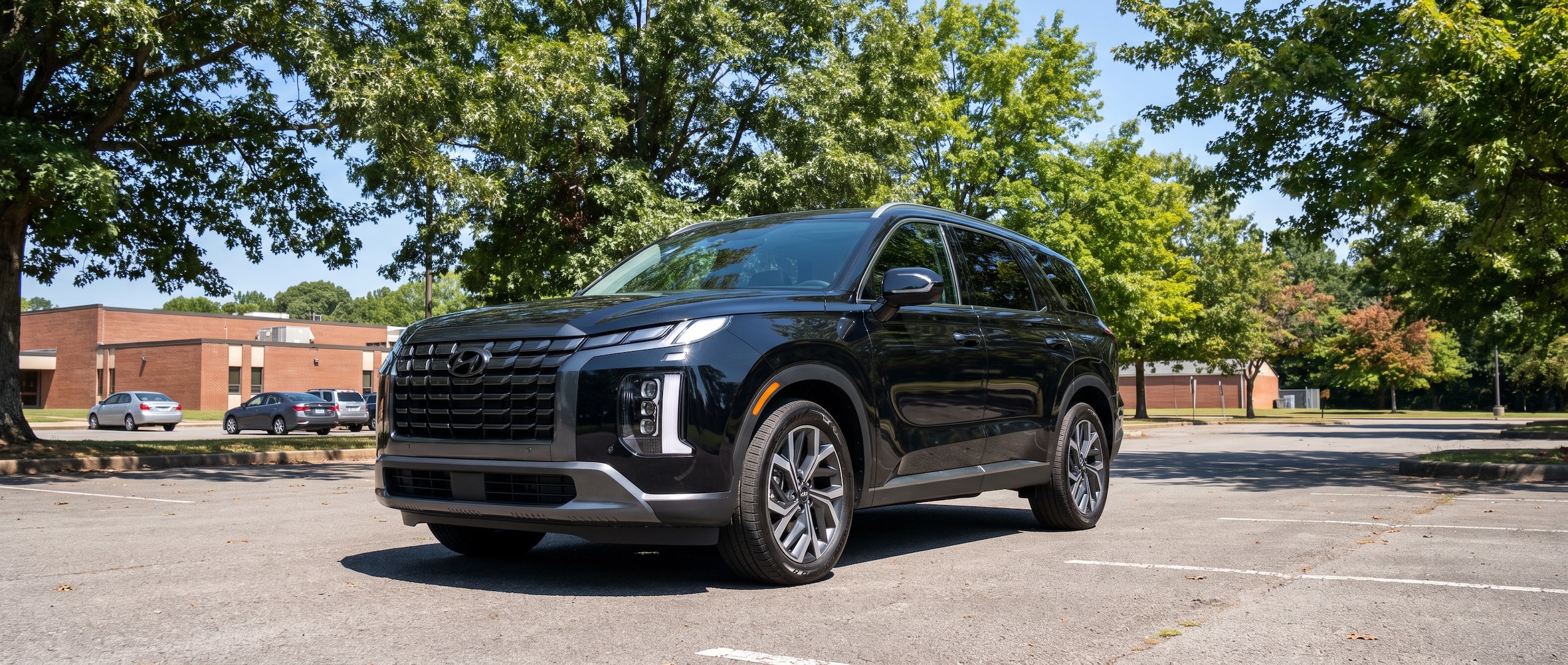
If your morning starts on Long Hollow Pike, you already know the drill. The lot fills fast, the drop-off lane moves in bursts of rolling stops and sudden starts, and whoever's riding in the third row has to step out safely into oncoming carpool traffic. These are the daily realities of a school drop-off, and they're exactly the conditions the 2026 Hyundai Palisade was engineered around. Understanding how it handles them is genuinely useful before you commit to a three-row SUV this size.
The plain version is short. The Palisade's standard safety stack and, on the Hybrid, its regenerative-braking powertrain both do their best work in exactly this kind of stop-and-go short-trip environment. For Beech High families, that shows up in two systems worth walking through.
The 2026 Palisade's Safe Exit Assist and regenerative braking hybrid system both do their best work in the stop-and-go rhythm of a school drop-off lane, not on the interstate.
How Does the Palisade's Safety Tech Actually Work at Drop-Off?
Safe Exit Assist earns its keep right where a school run gets tense, and it does real work without ever replacing an attentive driver, watching the blind zone behind your rear doors and holding a door shut when a car or cyclist is closing in from the lane you can't fully see.
The system is standard on every 2026 Palisade trim, including the base SE. If it detects an approaching vehicle or cyclist, it holds the door from opening fully and alerts whoever's about to step out. In a crowded drop-off lane on Long Hollow Pike, where the next lane keeps rolling, that does something no amount of "look both ways" coaching can guarantee. It pairs with Rear Cross-Traffic Collision-Avoidance Assist, also standard, so the Palisade has your back both when kids step out and when you reverse out of the spot later. You're covered coming and going.
Hyundai's SmartSense suite on the 2026 Palisade includes Forward Collision-Avoidance Assist (with pedestrian, cyclist, and junction detection), Lane Following Assist, Blind-Spot Collision Warning, Forward Attention Warning, and Navigation-based Smart Cruise Control with Stop and Go functionality. All of it comes standard. You don't have to step up to a higher trim to get the safety features that matter most at a school with nearly 1,500 students moving through a rural-fringe campus at the same time each morning.
| Safety Feature | How It Applies to School-Run Driving |
|---|---|
| Safe Exit Assist | Holds rear doors if traffic approaches; critical in active drop-off lanes |
| Forward Collision-Avoidance Assist (pedestrian) | Detects walkers and cyclists crossing in front during slow crawls |
| Rear Cross-Traffic Collision-Avoidance Assist | Alerts and brakes when backing out of a crowded parking spot |
| Blind-Spot Collision Warning | Monitors adjacent lane when merging back into traffic |
| Navigation-Based Smart Cruise Control (Stop & Go) | Manages speed in slow-moving carpool queues without constant pedal input |
| Forward Attention Warning | Monitors driver focus during repetitive, low-speed stop-and-go sequences |
The table above describes the standard trim. All of it ships on the SE.
Which Powertrain Do You Actually Need for Hendersonville's Short Trips?
For most Hendersonville families the Hybrid is the better daily match, though it does ask more of you up front, so the real call comes down to where your miles actually land between short school runs and the occasional long highway haul.
The Palisade Hybrid costs more than the gas V6 model, and if your driving were mostly long highway stretches at steady speed, the efficiency advantage would narrow. But the Hendersonville school-run is the opposite of a highway cruise. It's a sub-10-mile round trip with multiple full stops, idling in the drop-off queue, and low-speed crawling through a crowded lot.
A hybrid earns its keep in exactly that pattern. At low speeds the system leans on electric assist, and every time you slow for the carpool line it recaptures energy through regenerative braking. The EPA rates the Palisade Hybrid FWD at 33 city / 35 highway / 34 combined MPG. The gas V6 comes in at 18 city / 24 highway. City driving is where that 15 MPG gap shows up most clearly, and a stop-and-go school run is about as "city" as driving gets.
Under the hood: The Palisade Hybrid uses a 2.5-liter turbocharged four-cylinder paired with electric motors for a combined 329 horsepower and 339 lb-ft of torque. The gas V6 makes 287 horsepower and 260 lb-ft.
So the Hybrid ends up being both the more efficient and the more powerful option, which isn't how these comparisons usually go.
So which one fits? Browse the gas Palisade if your family does mostly weekend road trips and your daily driving genuinely skews highway. For a Hendersonville family whose primary use case is the Beech High run plus Nashville commute corridors, the Hybrid's city fuel numbers are the relevant comparison.
| 2026 Palisade V6 (Gas) | 2026 Palisade Hybrid | |
|---|---|---|
| Engine | 3.5L V6 | 2.5L Turbo + Electric Motors |
| Horsepower | 287 hp | 329 hp |
| Torque | 260 lb-ft | 339 lb-ft |
| EPA City MPG | 18 (AWD) | 29 (AWD) / 33 (FWD) |
| EPA Highway MPG | 24 (AWD) | 30 (AWD) / 35 (FWD) |
| Towing Capacity | Up to 5,000 lbs | Up to 4,000 lbs |
| Best Fit | Highway-heavy use, max towing | Short-trip / commute / school run |
One tradeoff here is blunt, and it's about towing. The Hybrid tows less, full stop. Its maximum towing capacity is 4,000 lbs versus 5,000 lbs on the gas model. If you regularly haul a boat to one of the coves along Old Hickory Lake on weekends, that 1,000-lb difference is worth pricing out carefully against the fuel savings.
Mini-Glossary: Palisade Powertrain and Safety Terms Explained
| Term | What It Means in Plain Language |
|---|---|
| Regenerative Braking | The hybrid captures kinetic energy when you slow down and converts it to electricity; the stop-and-go school run actually recharges the system constantly |
| HTRAC AWD | Hyundai's all-wheel drive system; distributes torque between front and rear axles automatically based on traction conditions |
| Safe Exit Assist | Monitors rear blind zones and resists door opening if a vehicle or cyclist is approaching from behind |
| Navigation-Based Smart Cruise Control | Uses map data to pre-adjust speed before curves and intersections, not just radar reaction |
| SmartSense | Hyundai's name for the full suite of standard driver-assist technology across the lineup |
What the Palisade's Cabin Means for Your Next Vehicle Choice
The cabin is where the Palisade quietly makes its everyday case, and it holds up well for teenagers in the third row even though the very back gets tight once the trip stretches past an hour or the passengers get tall.
The Palisade Hybrid seats up to seven in the standard captain's-chair configuration (the base SE can seat eight with a second-row bench). Third-row headroom runs up to 37.8 inches, a real number for teenagers and not just "technically a seat." Cargo behind the third row measures 19.1 cubic feet with all seats up. Fold the third row and you're at 46.3 cubic feet. Fold both rear rows and the Palisade opens to 86.7 cubic feet of load space, which is what you're thinking about when Beech High marching band season starts and the equipment bags come home.
Every 2026 Palisade also ships with wireless Apple CarPlay and Android Auto as standard, a factory-installed dual-angle dash cam (front and rear, records while driving or parked), and 100-watt USB-C ports throughout the cabin. For a family with multiple teenagers charging devices on a road trip, the USB-C detail is not trivial.
Our team's read is straightforward. If you're primarily replacing a minivan or a smaller three-row and your daily pattern centers on Hendersonville school logistics plus Nashville commute corridors, the Palisade Hybrid's powertrain advantage compounds over time in exactly the driving mix you're actually doing. If towing is your primary weekend use case, the gas V6's higher capacity and lower entry point deserve serious consideration. Both options are real vehicles for real families, and the right one depends on where your miles actually go.
Frequently Asked Questions
Does the 2026 Palisade's third row actually fit teenagers?
The 2026 Palisade's third row offers up to 37.8 inches of headroom. Hyundai also added one-touch second-row tilt-and-slide on certain trims to improve access to that back row. For average-sized high schoolers, it's a legitimate seat for shorter trips like the drive to Beech High, though taller passengers will find it tighter on longer hauls.
Is the 2026 Palisade Hybrid a plug-in electric vehicle?
No, the 2026 Palisade Hybrid is a self-charging hybrid, not a plug-in. The battery recharges through regenerative braking and the combustion engine during driving. There's no charging port, no charging cable, and no charge time to plan around.
What's the real fuel efficiency difference on a school run?
The EPA-estimated 34 combined MPG (FWD) for the Hybrid reflects the full hybrid cycle, including the electric assist the system uses in low-speed and stop-and-go conditions. The gas V6 comes in at 18 city MPG, which makes the Hybrid's efficiency advantage most visible in the exact kind of school-run driving pattern Beech High families experience.
Categories:
Social


