


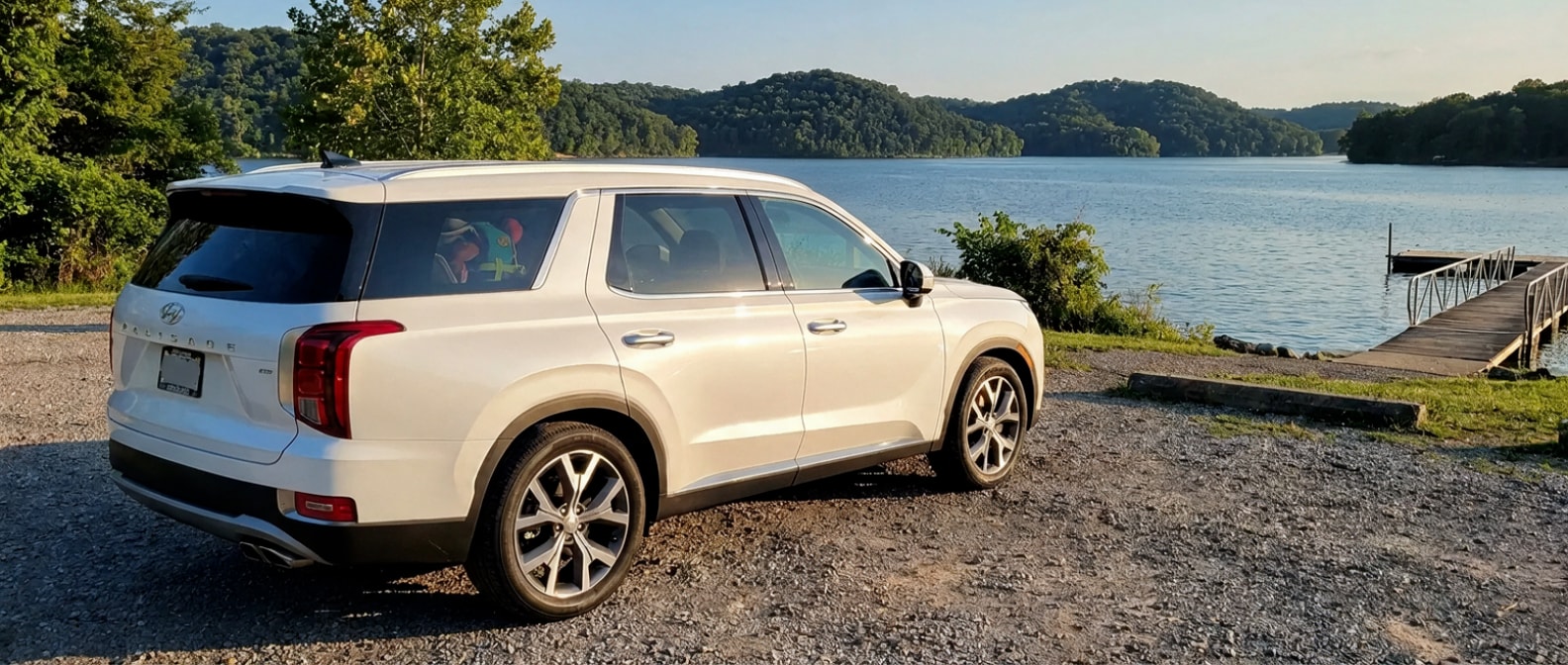
Pack the car for Bledsoe Creek State Park with a stroller, a cooler, and two kids arguing over legroom, and you already know you've outgrown something. The question isn't whether you need a different SUV, it's which Hyundai actually fits the way your family moves around Gallatin and Nashville.
Our quick take breaks down by family size. The 2026 Tucson is an excellent family vehicle for a household with two kids and no third-row ambitions. Need three rows but also use that cargo space most days? The 2026 Santa Fe steps in. And the 2026 Palisade (especially the Palisade Hybrid) is the one you'll buy when headcount, cargo capacity, and a long Nashville commute all have to coexist in a single vehicle. The genuine tradeoff is that bigger and more efficient costs more, and the Santa Fe's third row is tight enough that older tweens will notice it on a long drive.
Browse the 2026 Palisade at Hallmark Hyundai Hendersonville
The short version
- Small family (2 kids, one car) with a daily Nashville commute: the Tucson Hybrid's EPA-estimated 38 mpg combined is hard to beat
- Growing family (3 kids, gear-heavy weekends) needs the Santa Fe's three rows and 40.5 cubic feet of cargo behind the second row
- Largest families or carpool households: the Palisade seats up to 8 and offers 19.1 cubic feet even with all three rows up
- Efficiency-conscious buyers who need full three-row space: the Palisade Hybrid earns up to an EPA-estimated 34 mpg combined (FWD)
- All three come standard with Hyundai SmartSense driver-assistance technology
How Do the Tucson, Santa Fe, and Palisade Actually Compare?
All three seat a family and haul gear well, but they split on the one measure that outranks seat count, the cargo you have left after passengers sit down, and that gap is what sorts them across a family routine of school runs, Old Hickory Lake weekend trips, and a 25-to-30-minute Nashville commute.
| Feature | 2026 Tucson Hybrid | 2026 Santa Fe | 2026 Palisade Hybrid |
|---|---|---|---|
| Seating capacity | 5 | 6 or 7 | 7 or 8 |
| Cargo behind last row | 38.7 cu ft | 14.6 cu ft | 19.1 cu ft |
| Cargo (all rows folded) | 74.5 cu ft | 79.6 cu ft | 86.7 cu ft |
| EPA combined mpg | 38 mpg (est.) | 20-24 mpg (est.) | 29-34 mpg (est.) |
| Horsepower | 187 hp | 277 hp turbo | 329 hp (hybrid) |
| 2nd-row legroom | 41.3 in | 42.3 in | 43.0 in |
| 3rd-row legroom | N/A | 30.0 in | 32.1 in |
| Best for | Commuter family of 4 | Active family of 5-6 | Large family or carpool |
That table leaves out a few things worth knowing. The Palisade Hybrid runs noticeably quiet on the highway, which matters on a daily I-65 run into Nashville. The Santa Fe's turbocharged 277-horsepower engine pulls hard for a midsize SUV. And the Tucson Hybrid's 38-mpg combined rating (EPA-estimated) is genuinely unusual for a vehicle that seats five and carries nearly 38.7 cubic feet of gear with the rear seats up.
Which Powertrain Makes Sense for the Gallatin Commute?
For anyone covering 25-plus miles each way into Nashville, the hybrid is usually the smart pick, because fuel efficiency stops being a lifestyle choice here and becomes plain math, though which hybrid depends on whether you truly need the extra rows and cargo the bigger bodies bring.
See the Tucson Hybrid in our inventory
The 2026 Tucson Hybrid earns an EPA-estimated 38 mpg city and 38 mpg highway, both the same figure. That flat city-highway number happens because the hybrid system recaptures braking energy in stop-and-go traffic about as well as it coasts at speed. Head south on US-31E or I-65 along the Tennessee commuter corridor, and that balance carries over to real driving. If your household is a family of four without regular carpool duty, this is the powertrain that sharpens your per-mile cost with the least sacrifice in cargo room.
Check Santa Fe Hybrid availability
The Santa Fe Hybrid splits the difference with three rows, seating for up to seven, and real-world hybrid efficiency that improves significantly on the gas-only version's EPA-estimated 20 city / 29 highway. For families who need that third row for the occasional full car (grandparents along for a Bledsoe Creek hike, the soccer carpool) without wanting to drive a Palisade-size footprint every day, it's the sweet spot.
Palisade Hybrid on the commute: The EPA-estimated 33 city / 35 highway (FWD, Blue SEL trim) is strong for a vehicle with 86.7 cubic feet of maximum cargo space and seating for up to eight. The AWD configuration drops to 29 combined, still a meaningful step up from the gas-only Palisade's EPA-estimated 19 city / 25 highway. If the third row gets used often, the hybrid makes the Palisade's daily commuting economics much easier to justify.
The Palisade Hybrid's 329 horsepower and EPA-estimated 34 mpg combined (FWD) make it one of the few three-row family SUVs that doesn't force a tradeoff between performance, space, and efficiency.
In our experience the seat-count question tends to solve itself quickly. Cargo is where it gets trickier.
- The Tucson's 38.7 cubic feet behind the rear seats sounds big, but load two large strollers or a full week of lake gear and that fills up fast
- The Santa Fe's 14.6 cubic feet behind its third row is tight (really tight), but the second row folds to 40.5 cubic feet for gear-heavy days
- The Palisade's 19.1 cubic feet behind all three rows is a more generous number for a three-row SUV, and the third-row fold releases 46.3 cubic feet quickly
- All three carry Hyundai SmartSense standard (forward collision warning, lane-keeping assist, blind-spot monitoring)
- The Palisade comes standard with dual 12.3-inch displays across all trims
Picking by Family Situation
Pick by the point where each SUV stops being enough rather than by which one packs the most features, because a family of four, a family of six, and a full carpool each hit a different wall, and knowing which wall comes first is what makes the Tucson, Santa Fe, or Palisade the obvious call.
A family of four with kids under 10 and a daily Nashville commute is the Tucson Hybrid's exact use case. The EPA-estimated 38 combined mpg holds up on the highway and in the suburban stop-and-go around Gallatin, and 38.7 cubic feet behind the rear seats swallows the school-bag-plus-sports-equipment load without drama. The limitation is blunt. You're a five-passenger vehicle with a full trunk, and one more regular passenger changes the conversation.
A family of five or six who uses the third row regularly should be in a Santa Fe or Palisade. The Santa Fe's third-row legroom is 30.0 inches, which works fine for kids under 12. Teens won't last back there past about 45 minutes. For adults or older teenagers in that back row, the Palisade's 32.1 inches of third-row legroom is the more realistic number, and its 44.2 inches of front-row legroom keeps the driver comfortable on longer Nashville runs without feeling like they're surrendering space to the people behind them.
Families doing real carpool duty (five to eight people, gear, weather) land on the Palisade. The SE trim's bench seat maxes out at eight passengers, while the captain's-chair configurations drop to seven but open up second-row access in a way that matters when you're loading a full car of kids at school pickup. Plainly, it's a bigger machine.
Frequently Asked Questions
Is the 2026 Hyundai Tucson big enough for a family of five?
The 2026 Tucson seats five passengers and offers 38.7 cubic feet of cargo space behind the rear seats, expanding to 74.5 cubic feet with the seats folded. It handles a family of four comfortably. Five adults on a long trip starts to feel tight, particularly in the second-row shoulder room. A family of four with kids and regular gear hauling will likely find it fits well; if it's five adults who travel together often, you'll do better stepping up to the three-row Santa Fe.
Does the 2026 Hyundai Palisade Hybrid really get better mpg than the gas version?
Yes, meaningfully so. The gas-only Palisade is EPA-rated at 19 city / 25 highway, while the Palisade Hybrid (FWD, SEL and SEL Premium trims) earns EPA-estimated 33 city / 35 highway. On a daily Gallatin-to-Nashville commute, that efficiency gap adds up across a full calendar year. The tradeoff is that the Palisade Hybrid's AWD configuration drops to 29 combined, so if you're after both all-wheel drive and maximum efficiency, the FWD hybrid trims are the more fuel-conscious choice.
Categories:
Social


