


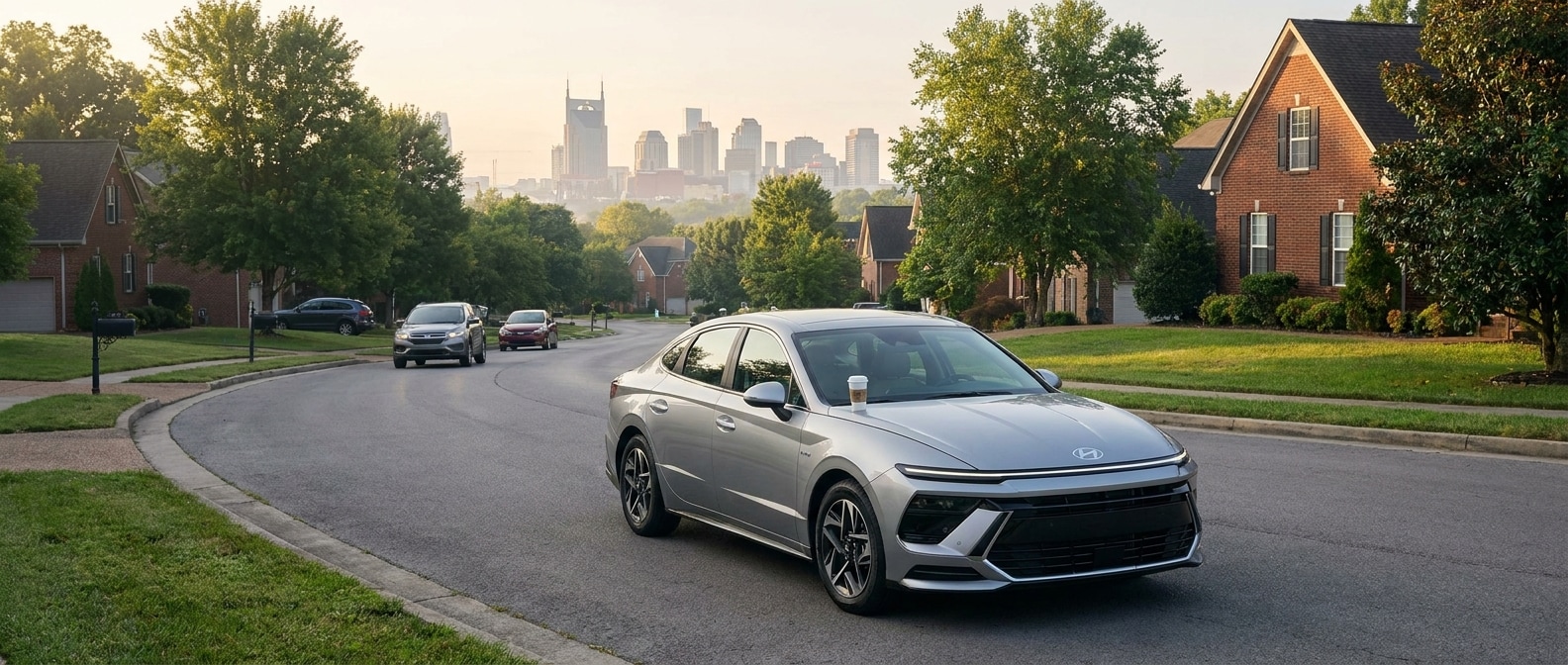
If you drive from Hendersonville into Nashville every morning, the Sonata vs. Camry question isn't really about brand loyalty. It comes down to which sedan earns its keep on Vietnam Veterans Boulevard before you ever touch I-65. And the answer hangs on one split decision, gas or hybrid, plus how much AWD matters to you in January.
The 2026 Hyundai Sonata Hybrid does something the 2026 Toyota Camry can't. It gives you a genuine gas-only option alongside a class-leading hybrid, so you're not locked into a single powertrain. The Camry went hybrid-only starting with the 2025 model year and hasn't looked back. For buyers who want that choice, the difference is real and meaningful.
Below is our read on how both cars perform for the commute you're actually running.
How Far Will Your Fuel Dollar Really Go on This Commute?
On a Hendersonville commute your fuel dollar goes furthest in a hybrid, and the win comes from the stop-and-go grind rather than the interstate, because that boulevard crawl is exactly where regenerative braking captures energy a pure gas engine would otherwise discard as heat every single morning. Vietnam Veterans Boulevard runs between Hendersonville and I-65. It stacks up during the 7:00-8:30 a.m. window, and that rhythm is the condition a hybrid was tuned for.
Start with the raw efficiency figures, because that's where the choice usually gets made. The EPA rates the 2026 Sonata Hybrid Blue at 47 city / 56 highway / 51 combined mpg. The Sonata Hybrid SEL and Limited trim out at 44 city / 51 highway / 47 combined. On the gas side, the 2026 Sonata SE earns 28 city / 38 highway / 32 combined. The 2026 Camry is hybrid-only and tops out at 52 city / 49 highway / 51 combined mpg on the LE FWD, with the SE, XSE, and XLE trims coming in at 47 city / 45 highway / 46 combined.
Below is how the powertrain choices line up for the Hendersonville-to-Nashville run.
| Powertrain Option | City MPG (EPA) | Highway MPG (EPA) | Combined MPG (EPA) | AWD Available? |
|---|---|---|---|---|
| 2026 Sonata Hybrid Blue | 47 | 56 | 51 | No (FWD only) |
| 2026 Sonata Hybrid SEL / Limited | 44 | 51 | 47 | No (FWD only) |
| 2026 Camry LE (FWD) | 52 | 49 | 51 | No (LE base) |
| 2026 Camry SE / XLE / XSE (FWD) | 47 | 45 | 46 | Yes (upgrade) |
| 2026 Camry (AWD, any trim) | 46 | 46 | 46 | Yes (standard on AWD) |
| 2026 Sonata SE (gas) | 28 | 38 | 32 | No |
| 2026 Sonata SEL Sport (gas, FWD) | 25 | 36 | 29 | No |
| 2026 Sonata SEL Sport (gas, AWD) | 24 | 33 | 27 | Yes |
For this particular commute, the Sonata Hybrid Blue's 47 city rating matters more than its 56 highway number. Roughly half of a Hendersonville-to-downtown trip runs at stop-and-go surface speeds where regenerative braking works hardest. On the I-65 stretch, both the Sonata Hybrid and the Camry hybrid systems run lean and efficient, and the gap between them narrows. Where the Sonata's city number pulls ahead of the Camry's mid-tier trims is in that boulevard grind before the on-ramp.
One tradeoff worth naming up front is drivetrain. The 2026 Sonata Hybrid is front-wheel drive only, and no AWD option exists on any hybrid trim. The Camry offers AWD across its lineup. If your winter commute worries you on Tennessee ice, that matters. We'll come back to that.
See Current Sonata and Sonata Hybrid Offers
Where Does Each Car Win Inside the Cabin?
The 2026 Sonata takes most of the cabin honors while the Camry claims one important row, and the headline is size, with the EPA classifying the Sonata as a large car rather than a midsize because its total passenger volume of 104.4 cubic feet beats the Camry's 99.9 cubic feet by 4.5 cubic feet. Front headroom, front legroom, and front shoulder room all favor the Sonata. If you're tall and spending 30 minutes each way in that driver's seat, you'll feel the difference.
The Camry wins one specific dimension, and it's rear legroom. It has roughly 3.2 inches more rear legroom than the Sonata. For a couple commuting together with adults riding regularly in the back, that's a real consideration. Not a dealbreaker for most solo commuters, but worth naming plainly.
On tech, the 2026 Sonata ships with a 12.3-inch infotainment screen standard. The Camry's base screen is 8 inches, and the 12.3-inch display comes only on upper trims. Wireless Apple CarPlay and Android Auto are standard on both. For the morning podcast listener or navigation-heavy commuter, the larger standard screen is a daily-use difference.
On cargo, the Sonata Hybrid carries about 16 cubic feet, and the Camry holds 15.1 cubic feet. The Sonata also uses concealed beam hinges that don't eat into usable space the way the Camry's hinge design does.
Team observation: On the gas vs. hybrid decision for a Hendersonville commute, the break-even math shifts in favor of the Hybrid specifically because Vietnam Veterans Boulevard delivers meaningful stop-and-go mileage before the I-65 run. Regenerative braking isn't theoretical here. The boulevard's rhythm is the very condition the system was built for.
- [ ] Identify your commute pattern: mostly boulevard stop-and-go, mostly I-65 highway, or a genuine split
- [ ] Decide whether AWD matters for your January and February mornings
- [ ] Compare the Sonata Hybrid's city rating (47 mpg) against the Camry LE's city rating (52 mpg) if the base trim is your target
- [ ] Check whether you regularly carry adults in the rear seats (Camry wins that room)
- [ ] Confirm which screen size and standard tech matter in your daily routine
- [ ] Test-sit both driver's seats if you're above average height; the Sonata's front headroom advantage is real
Plan Your Powertrain Decision This Way
Your powertrain decision really comes down to commute shape and winter nerves, so start with the Sonata Hybrid, which is the right fit when you want the best gas/hybrid efficiency on a split commute, you drive alone or with one other adult most days, front headroom matters, and AWD isn't a priority. The gas Sonata makes sense if you want powertrain flexibility (including the 290-hp N Line option the Camry can't match) and you're comfortable running FWD through Tennessee winters.
The Camry earns its place when you want AWD available on any trim you choose, you regularly carry adults in the back seat, and you're comfortable with a hybrid-only powertrain. Its 51 combined mpg on the LE trim is genuinely competitive with the Sonata Hybrid. The Camry's clearest advantage is that AWD access on every trim, which the Sonata Hybrid simply doesn't offer.
Both earned equivalent NHTSA crash test ratings (5 stars overall on 2025 models, with 2026 expected to be similar per NHTSA) and IIHS Top Safety Pick recognition. Safety isn't the differentiator here. Powertrain flexibility and interior fit are.
Our suggestion runs like this. If you're in the Sonata camp, the Hybrid Blue or Hybrid SEL is where the commute math works best for Vietnam Veterans Boulevard. If the Camry's AWD in winter is what tips you, that's a legitimate and verifiable reason to go that direction. We'd rather say that plainly than pretend it isn't a real tradeoff.
Browse our current Sonata and Sonata Hybrid inventory
Frequently Asked Questions
Is the Hyundai Sonata Hybrid more efficient than the Toyota Camry for a Nashville commute?
On a mixed commute that includes stop-and-go boulevard driving followed by I-65 highway miles, the 2026 Sonata Hybrid Blue's EPA-estimated 47 city / 56 highway mpg is competitive with the 2026 Camry LE's 52 city / 49 highway mpg. The Sonata Hybrid's city number is lower than the Camry LE's city figure, but its highway number is higher. For a Hendersonville-to-Nashville run that mixes surface roads and interstate, real-world efficiency for both will land close to their respective combined ratings, 51 mpg combined for both the Sonata Hybrid Blue and the Camry LE FWD. The Sonata Hybrid SEL and Limited trims come in at 47 combined. Either way, the gap between the two at the combined level is small for most of this commute's actual mix.
Does the Toyota Camry have AWD and the Sonata Hybrid not?
Yes, and that's the clearest tradeoff in this comparison. The 2026 Toyota Camry offers AWD as an upgrade on every trim in its lineup. The 2026 Hyundai Sonata Hybrid is front-wheel drive only, and there's no AWD option on any Hybrid trim. The 2026 Sonata SEL Sport gas trim does offer available AWD, so if all-wheel drive matters to you, the gas Sonata with AWD is the Hyundai path. Tennessee winters are generally mild, but Hendersonville does see ice on roads in January and February, and AWD provides a genuine traction margin on those mornings. If winter driving is a real concern, the Camry's AWD availability across all trims is a meaningful advantage.
Will the Sonata Hybrid's regenerative braking actually help on my specific commute?
Regenerative braking recovers kinetic energy during deceleration and converts it into electricity that charges the hybrid battery rather than losing it as heat. On Vietnam Veterans Boulevard toward I-65, where traffic stacks in the morning window and involves repeated brake applications at signals and merge points, the system works consistently. On the sustained I-65 stretch at highway speed with fewer stops, the regenerative benefit drops because you're braking less often. A commute that's split between boulevard stop-and-go and highway cruise will see meaningful efficiency from regen in the boulevard portion. A commute that's nearly all highway from the start will see a smaller advantage. The EPA estimates are based on a standardized city/highway cycle, and your actual split determines how close to the city figure or the highway figure your real-world number lands.
Categories:
Social


