

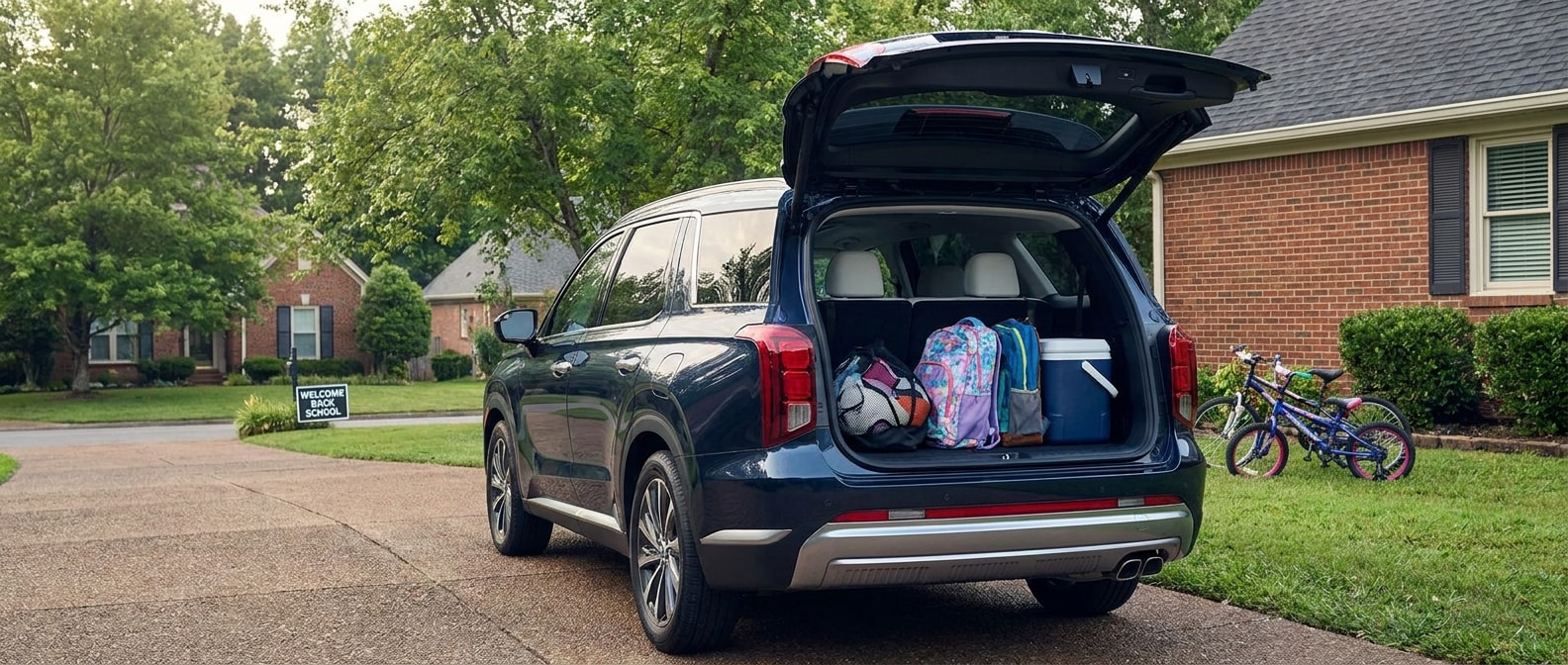
For most Hendersonville families running the school-year gauntlet, the 2026 Palisade is the stronger pick, and here's the short version of why. It seats up to eight, carries more cargo with everyone on board, earns the IIHS's 2026 Top Safety Pick+ rating, and the Hybrid variant cuts commute fuel costs significantly. The Explorer has a real edge if you regularly tow a trailer or want a more driver-focused feel, and we'll tell you exactly when that matters.
- The 2026 Palisade offers 19.1 cu ft of cargo behind its third row versus the Explorer's 16.3 cu ft. That difference is tangible on a school morning.
- Palisade seats eight (optional bench). Explorer starts at six and maxes out at seven. One more body fits in the carpool.
- The EPA rates the 2026 Palisade Hybrid at a targeted 34 mpg combined. On a 20-mile Nashville commute that adds up fast.
- The 2026 Explorer tows up to 5,000 lbs and offers an available 400-hp engine. Palisade tops out at 287 hp on gas.
- For families anchored in school logistics, the Palisade wins on space and efficiency. For families who haul gear, boats, or want spirited highway driving, the Explorer earns its keep.
Browse the 2026 Palisade at Hallmark Hyundai Hendersonville
What's the Real Difference Between These Two?
Both of these are legitimate three-row family SUVs, priced close together at similar trim levels and nearly identical in exterior length (Palisade at 199.2 inches, Explorer at 198.8 inches). The gap people feel isn't in the footprint. It's inside the cabin.
| Spec | 2026 Hyundai Palisade | 2026 Ford Explorer |
|---|---|---|
| Engine | 3.5L V6, 287 hp | 2.3L EcoBoost I4, 300 hp (400 hp V6 available) |
| EPA Combined (gas) | 21 mpg (FWD) / 20 mpg (AWD) | 24 mpg (base FWD) |
| Hybrid Option | Yes (34 mpg combined targeted) | No |
| Seating | 7 or 8 | 6 or 7 |
| Cargo Behind Row 3 | 19.1 cu ft | 16.3 cu ft |
| Max Cargo (all rows flat) | 86.7 cu ft | 85.8 cu ft |
| Third-Row Legroom | 32.1 inches | 31.8 inches |
| IIHS Safety Award | 2026 TSP+ | Good ratings (all tests) |
| Towing Capacity | Available hitch; lower tow rating | Up to 5,000 lbs (equipped) |
Living with the cabin day to day, the difference gets obvious. The Palisade's redesigned interior uses soft-touch materials and a horizontal dash layout, with dual 12.3-inch screens and 100-watt USB-C ports in every row. (Yes, all three rows.) The Explorer runs a 13.2-inch Google-powered infotainment screen that genuinely works, and Ford's BlueCruise hands-free highway driving is available at higher trims. Call it two philosophies, one tuned for comfort in transit, the other for driver feel and capability.
Does the Third Row Actually Fit Your Kids?
Both work for children, but the Palisade fits tweens and the occasional adult guest better, and the numbers back that up. At 32.1 inches of third-row legroom, Hyundai lists genuine space, and we find it accommodates kids up through middle-school age without a fight. The Explorer's 31.8 inches of third-row legroom is close, though the difference between "workable" and "comfortable" often comes down to that quarter-inch on a 30-minute ride home from practice.
What matters more for school families is access. The Palisade's available captain's chairs in row two come with one-touch tilt-and-slide for easy third-row entry. That helps when you're loading four kids after a rainy soccer game. The Explorer's E-Z Entry mechanism handles the same job, and parents who've tested it report it's intuitive, but the Palisade's one-touch operation is faster under load.
See the Palisade Hybrid lineup
The seating count, though, is the bigger story. The Explorer maxes at seven, with six seats as the default configuration in most trims. The Palisade can seat eight with its second-row bench, meaning you can genuinely fit three children across row two and still run a seventh or eighth passenger in the third row. If your household runs two separate soccer carpools on the same Saturday, that extra seat isn't trivial.
View current Hyundai inventory in Hendersonville
Cargo and Commute: The School-Year Reality
Three-row SUV cargo specs always look fine until you're staring at 19.1 cubic feet behind row three on a Monday morning with four backpacks, two lunchboxes, a trumpet case, and a lacrosse stick. Hyundai lists 19.1 cu ft for the 2026 Palisade's behind-row-3 space. The Explorer lands at 16.3 cu ft in the same configuration. Neither number is huge. The Palisade's advantage is nearly 3 cubic feet, roughly enough for one additional large duffel or that awkward instrument case that never lays flat.
Now the honest tradeoff on fuel. The base 2026 Palisade with FWD is EPA-rated at 21 mpg combined, and a Hendersonville commuter running 40 miles round-trip daily will notice that number. The Explorer's base 2.3L I4 earns a higher 24 mpg combined on EPA estimates, which is a meaningful gap on gas costs over a school year. Here's where the calculus shifts. The 2026 Palisade Hybrid targets 34 mpg combined, which Hyundai has announced, and that's a different conversation entirely. If the commute is the main variable in your decision, the Palisade Hybrid closes the efficiency question and goes well past the Explorer.
Safety for the School-Year Carpool
The 2026 Palisade (built after November 2025) earned the IIHS 2026 Top Safety Pick+ award, the organization's highest designation. IIHS testing assessed moderate front overlap, small front overlap, side impact, and pedestrian crash prevention, and the Palisade earned high marks across all. Hyundai also added ten airbags (including third-row coverage) and seatbelt pretensioners for all three rows, which matters specifically when your third-row passengers are the kids you're responsible for.
On the Ford side, the 2026 Explorer holds NHTSA's 5-star overall safety rating and earned Good ratings (the top score) across IIHS crash tests. Standard Ford Co-Pilot360 includes automatic emergency braking, blind-spot monitoring, and lane-keeping assist. The Explorer's safety tech is thorough, and it's a safe vehicle. The Palisade simply reached the higher combined IIHS award level in the most current testing cycle.
One spec stands out for carpool families. The Palisade's Safe Exit Assist alerts passengers before they open a door into traffic, and on a crowded school drop-off loop, kids climbing out into moving vehicles is a real hazard. That feature comes standard.
Explore Palisade trims and features
So Which Should You Pick?
Here's where generic comparisons stop being useful, so we'll be direct.
Pick the 2026 Palisade if: your household runs school logistics as the primary mission (multiple kids, recurring carpools, sports gear in the back, and a Nashville-area commute where fuel costs compound over a 10-month school year). The 8-seat option, the larger behind-seat cargo volume, the flat-folding floor, and the TSP+ safety rating all serve that specific use case. If you're adding the Hybrid, the efficiency argument over the Explorer's base engine isn't close.
Pick the 2026 Explorer if: you regularly tow (a boat for Percy Priest Lake summer trips, a cargo trailer, a camper). The Explorer's 5,000-lb tow rating (properly equipped) is a genuine capability advantage the Palisade can't match. The available 400-hp ST or Tremor trims also serve families who want the three-row utility but prioritize a more dynamic driving character. And if six or seven seats is all you ever need, you won't miss the eighth.
The honest concession: the base Palisade gas model trails the Explorer's combined EPA estimate by 3 mpg. That's real over a school year. If you're choosing the gas-only Palisade, budget the fuel difference. If you're comparing Palisade Hybrid to the Explorer's gas engine, the efficiency math flips entirely.
For most Hendersonville families prioritizing school-year logistics, the Palisade is the call we'd make. We stock both the standard and Hybrid variants so you can compare them side by side.
Frequently Asked Questions
Does the Palisade or Explorer have more third-row legroom?
The 2026 Palisade lists 32.1 inches of third-row legroom per Hyundai's specifications. The 2026 Explorer measures 31.8 inches in the third row per Ford's published dimensions. The difference is small, but the Palisade also offers more cargo space behind that third row (19.1 cu ft versus 16.3 cu ft), which is the more practically significant gap for school-age families.
Is the Palisade Hybrid worth the upgrade over the base gas model for a Nashville commuter?
For a daily commuter covering 40 or more miles round-trip through the Nashville metro area, the Palisade Hybrid's targeted 34 mpg combined is a substantial improvement over the base gas model's EPA-rated 21 mpg combined. The hybrid powertrain also delivers an estimated 329 horsepower combined, so you're not giving up capability to gain efficiency. The trade-off is a higher starting point in the trim structure, which is worth mapping against your annual mileage to see whether the fuel savings justify the difference for your specific situation.


